

Introducing Test Sets in Jedify
A few months ago, I joined a customer call where the team was excited about what they were building on top of Jedify’s semantic fusion model. They loved how quickly they could ask questions in plain language and get answers that used their data correctly.
Then someone asked the question everyone thinks about at some point.
“But how do we know it will answer the same way tomorrow?”
For a moment, no one said anything.
Not because the model was unreliable, but because there wasn’t an easy way to prove its accuracy in a way both data and business teams could align on.
That moment stuck with us.
It also reminded us of something every data team knows well.
Data quality has always been the pillar of traditional data intelligence. Pipelines, models, dashboards, governance. All of those elements are built so teams can trust the numbers they rely on. But in the AI world, the logic becomes more fluid. Answers are not always deterministic, context shifts, and reasoning happens dynamically. Still, the need to trust your data has not changed. No compromises, even if the technology behaves differently.
So we built something that removes the guesswork and brings that foundation into the AI era.
Test Sets
A new way to validate accuracy and consistency in your Semantic Fusion Model.
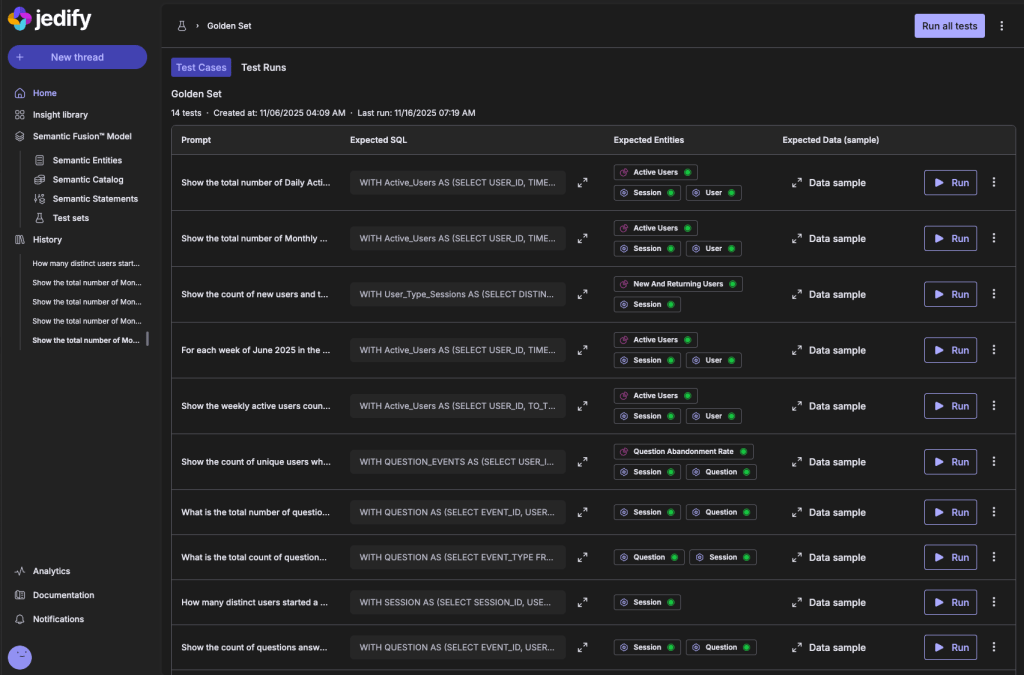
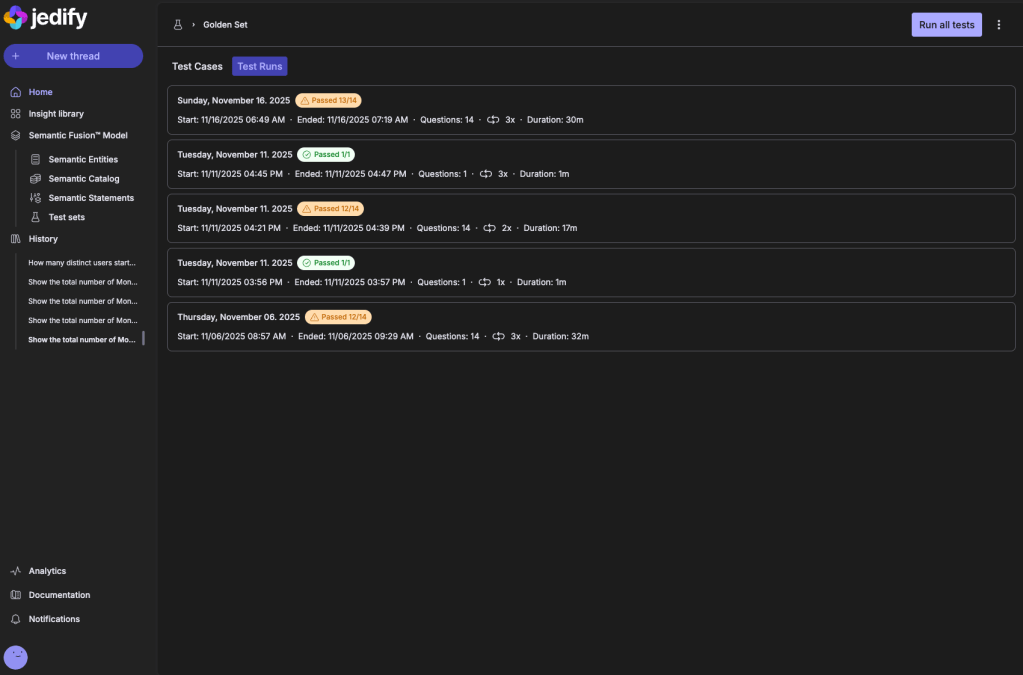
Test sets let you define expected outputs for real business questions. Jedify then runs those questions against the model and tells you how well it performs. Instead of hoping the model behaves the same each time, you can measure it, monitor it, and improve it with clear signals.
This is more than QA.
It is the missing link that lets companies operationalize AI-driven data intelligence with confidence.
Data teams get a validation layer that fits naturally into their workflow.
Business teams get a shared language for accuracy.
Everyone gets visibility into how reliable the model really is.
The result is simple.
You can trust your data and trust the answers you get, not because it feels right, but because you can prove it.
Accuracy becomes visible instead of assumed. Quality becomes measurable instead of debated. And the entire organization can move from cautious adoption to real operational use, supported by clear proof that the model behaves the way it should.