Ask a typical AI agent: “Why did revenue drop 22% last quarter?”
You’ll get: “Revenue dropped because enterprise customer churn increased 30%.”
That’s not an answer. That’s a restatement. Someone still has to manually investigate: check product changes, analyze competitor activity, review support tickets, examine pricing
impacts. The agent, like agents often do, picks the easiest path of least resistance, which is shallow and irrelevant to pinpointing causation,
Take this question: “Why did renewal rates drop for customers who signed up in Q1 2023?”
Answering requires understanding cohort boundaries, comparing this group to others, investigating what changed specifically for them, testing multiple hypotheses, and quantifying
impact.
No single query gets you there. You need iteration: collect initial data, form hypotheses, collect more targeted data, challenge the hypotheses, test alternatives, overall – a very human intelligence type of task.
How Jedify tackles this
Planning is key
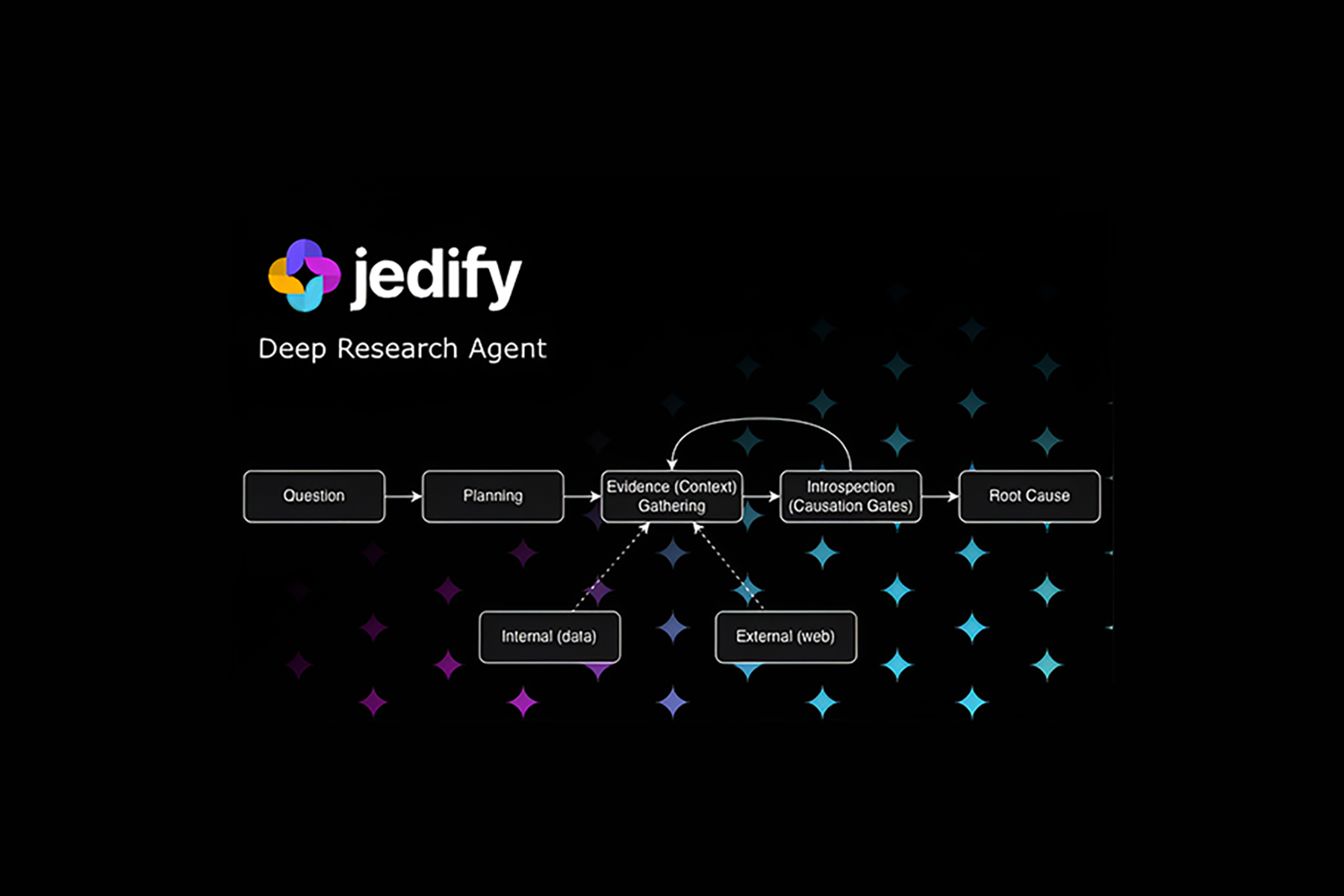
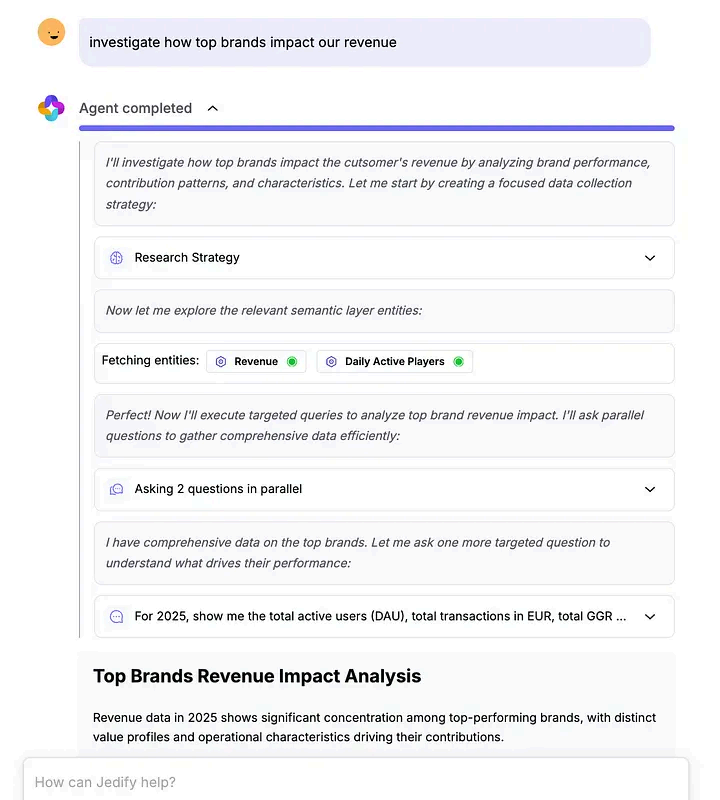
Deep research requires planning. The agent starts with a high-level digest of the customer’s semantic layer, using it to identify which entities require deeper investigation.
With full semantic context, the agent generates multiple competing hypotheses to validate—a deliberate step to prevent confirmation bias. This hypothesis generation can happen before or after initial data collection; the agent decides early based on what orientation is needed.
Once hypotheses are set, data collection begins—anywhere from one to a dozen or more queries. This breadth enables deeply grounded conclusions, but also creates risk: with broad context, LLMs can easily diverge or hallucinate.
Introspection – The Three-Gate Framework
To address this divergence risk, we built an introspection framework that forces analytical depth.
Gate 1: Evidence Strength Assessment The system evaluates whether causal claims have sufficient support. Weak evidence shows temporal coincidence (“revenue dropped and a competitor launched the same quarter”). Strong evidence shows temporal sequencing, mechanism verification, and multiple confirming signals (“revenue dropped starting March 15, competitor launched March 15, 73% of exit interviews cite competitive pricing”). With weak evidence, the agent must strengthen the causal chain through follow-up questions or web searches before proceeding.
Gate 2: Hypothesis Coverage Check The agent must test at least two competing explanations before concluding causation. If it only investigated product changes, it must also test pricing or competitive factors. This forces the agent to seek disconfirming evidence—you can’t claim “X caused Y” without checking if Z might have caused it instead.
Gate 3: Root Cause Depth Verification The system distinguishes symptoms from root causes by asking: “Would a stakeholder ask ‘but WHY did that happen?'” Symptoms like “churn increased” require further investigation. Root causes like “Feature X was removed on March 1” are actionable. The agent drills until reaching concrete actions or events.
Real example from production:
Question: “Why is Publisher X’s ad fill rate 30% vs 60% benchmark?”
- Phase 1: “Demand is low” → Gate 3 triggers (symptom)
- Phase 2: “Only 3 of 11 demand partners are active” → Gate 3 triggers again (still a symptom)
- Phase 3: “Eight signed demand partner deals haven’t been activated due to incomplete integration setup” → Gate 3 passes (actionable)
Going Beyond Your Database: External Factor Investigation
Your data shows what happened inside your company. But competitor launches, market shifts, and regulatory changes live outside your warehouse.
The research agent integrates web search into its investigation. When one operator’s adoption dropped 40% in March with no internal changes—no product updates, no pricing shifts—the
agent searched external sources. It found the operator had announced bankruptcy March 1st. Internal data showed the symptom. Web search revealed the root cause.
In addition – some important factors may not be present or accessible online, the agent is aware of that and is tuned to prompt the user to fill in information gaps it identifies.
When data becomes useful
When you ask “why,” you’re not looking for a data point. You’re looking for leverage—something you can act on, change, or decide against.
The gates, the planning, the external search—all of it exists to close that gap. To take a question like “why are renewal rates dropping?” and return not with a symptom to investigate, but with a root cause to address. That’s when data stops being informative and starts being useful.