We’ve been in the data business for a long time. More than 15 years, in fact, if you count from when Adi, Erik and I first started working together to build an open-source intelligence data platform, back when ingesting massive, fragmented data sources and making sense of them at scale was considered genuinely hard.
It was hard, both when scaling a startup rapidly and post-acquisition as part of a multinational organization. We kept running into the same wall: no matter how sophisticated the organization and its access to technology, harnessing intelligence from data at scale was always painful, always expensive, and almost never good enough.
About two years ago, when language models emerged, that frustration became an opportunity to finally deliver the intelligence needed for software applications, AI agents, humans and more to fulfill their purpose at scale. This is what brought us back together to build Jedify. And today, as we come out of stealth, we’re excited to share that we’ve raised $24 million in Series A funding, bringing our total to $33 million. The round was led by Norwest Venture Partners, with strategic participation from Snowflake, our existing investors S Capital VC and Cerca Partners, and a new investor, Oceans Ventures.
The funding will accelerate everything, from our core technology and product development to our go-to-market strategy. We’re already working with companies across cybersecurity, media and enterprise software who are building some genuinely exciting things on top of Semantic Fusion™, our context graph technology, and we’re only getting started!
But more than the funding itself, I want to share why we’re building, and why I think the next few years are going to make it look obvious in hindsight.

Enterprises Aren’t Ready for a World Moving Toward Agentic AI
The way enterprises work with data and software is in the midst of a fundamental shift. For years, companies have accumulated dozens (or sometimes hundreds) of SaaS tools, each with its own data, its own UI, its own silo.
The fragmentation went deeper than the software. Companies built teams, job descriptions, ownership models, and operating rituals around the boundaries of these tools, instead of around the actual flow of the business. CRM owns one part of the customer, Product owns another, Marketing owns another, and suddenly something as basic as defining and executing a customer funnel strategy requires a meeting with representatives from every silo. That is not how the business really runs. But that era is coming to an end. An agentic solution should operate across all of that data and context, encapsulating the relevant functions into a purpose-built workflows that reflect the company’s actual dynamics, not the artificial lines drawn by its software stack. The potential here to take on tasks, make decisions and operate autonomously across a business is enormous, and it’s more than just incremental efficiency gains. Agentic AI can create genuinely transformative outcomes across finance, sales, marketing, product, customer success—you name it.
But here’s the problem: most agentic solutions that exist today are hitting a wall. They can be impressive in demos, but they can easily fall apart in the real world. And the reason is almost always the same: they don’t actually understand the business they’re supposed to be serving. They lack context.
Context is the Hard Part. That’s Why Nobody’s Been Solving It Properly.
When we talk about context, we don’t mean feeding an agent a handful of documents or a database schema. It’s more about the kind of deep, nuanced, interconnected understanding that lets an agent actually reason about your business the way a smart, experienced employee would.
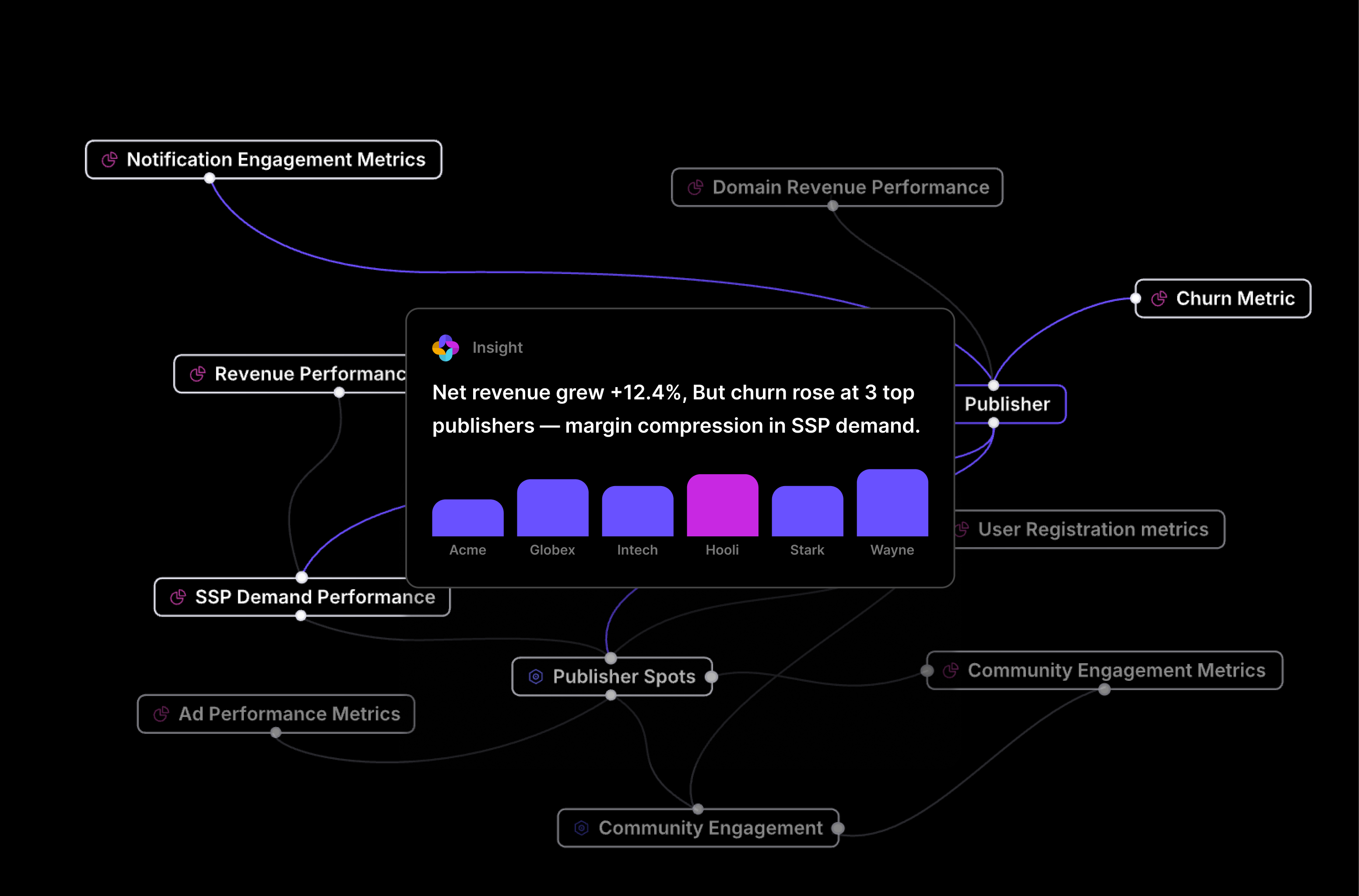
If you know what it means to truly understand a customer, you know what I’m talking about. It’s not just their CRM record. It’s the tickets they’ve filed in Zendesk, the patterns in their usage data, notes from their last QBR, the Gong calls, and the list goes on. These things live in completely different systems, often in completely different formats, with structured data on one side and blobs of text on the other. When you can connect them, the lightbulb goes on: the graph might see a specific complaint in a ticket and automatically link it to a deal stage in the CRM, without anyone having to tell it what to look for.
That’s the “a-ha” moment we see with customers: when they look at the context graph and say, “Oh, it actually knows my business.” That’s what we’re building.
Context Graphs: To Agentic AI What Observability Was to Cloud Infrastructure
Here’s how I think about where we are in this market. When cloud infrastructure started to scale, teams ran into new categories of problems that hadn’t existed before. Things like debugging distributed systems or fully understanding performance across microservices.
Nobody was talking about observability as a category in 2010, but by 2018, it was a must-have. Now you can’t run serious cloud infrastructure without it.
Context graphs are following the same trajectory for agentic AI. Right now, most teams building agents are handling context manually, and in our opinion, tediously: writing long prompts, maintaining markdown files, skills and instructions by hand, rebuilding everything when something changes.
It’s slow, mistake-prone, and it just doesn’t scale.
In five years, we believe everyone will look back and say, “Of course you can’t run production agents without a dedicated context layer.
Our vision is for every enterprise to have a context graph (or a few), a living, always up-to-date, autonomous, compounding representation of the business that all of their agents, applications and AI workflows draw from. It’s not a static snapshot, but rather something that continuously learns, evolves and gets smarter every time it’s used.
Your Context Graph Shouldn’t Belong to Your Model Provider
This is something I feel strongly about, and I think it’s important to say directly. There’s been a wave of moves recently from major model providers like OpenAI, Anthropic and Google, offering enterprises what are essentially forward-deployed engineers and professional services to help solve the context problem.
We obviously understand why. It’s a real gap, and there’s real demand. But I’d encourage enterprises to think carefully about the structure of that arrangement.
Your context graph is, in many ways, your most valuable data asset. It encodes how your business works, what your customers look like, how you define performance and what your own internal terminology means. Handing that to the same vendor who charges you per token to use it creates a fundamental conflict of interest. They benefit from complexity, which breeds token consumption. The last thing they’re incentivized to do is make your agents lean and efficient.
Independence matters. Your semantic layer should belong to you, work across any model you choose, and become less dependent on any single vendor.
Being model-agnostic at Jedify isn’t a feature; it’s a principle.
To learn more about the platform and its capabilities, book a demo with the Jedify team.
![13 Best Customer Data Platforms for Retail [By Industry Segment]](https://jedify.com/wp-content/uploads/retail_cdp_hero.svg)