Abstract
- Semantic layer tools create governed business meaning that data consumers, from BI platforms to AI agents, can reuse consistently.
- The category now spans metrics layers, BI semantic models, governed data-access layers, and AI-ready context infrastructure.
- The right fit depends on how each platform handles semantic modeling, governance, agent-facing delivery, distributed data, and implementation effort.
- For agentic AI, metric definitions alone may not be enough. Reliable agents increasingly need reusable context that combines enterprise data, BI logic, and broader business knowledge.
- The article compares 15 leading tools across these requirements.
Semantic layers are no longer only about keeping dashboards consistent.
You now need a semantic infrastructure that supports BI, self-service analytics, natural-language investigation, and AI agents without having to rebuild business logic for every tool. Deloitte’s 2026 State of AI report found that 42% of companies believe their AI strategy is well-prepared. Still, they feel less prepared in infrastructure, data, risk, and talent.
This guide compares semantic layer tools by use case, so you can shortlist the right fit for your data stack, analytics workflows, and agentic AI roadmap.
What are semantic layer tools?
Semantic layer tools create a governed, business-facing layer between raw data and the people, BI tools, applications, or AI systems that use it. Instead of making every dashboard, analyst, or agent interpret schemas directly, they define reusable concepts such as revenue, active customer, churn risk, product adoption, sales pipeline, and customer lifetime value.
These solutions solve a common enterprise data problem: business meaning is fragmented. Metrics are often calculated differently across dashboards, while BI logic may live in LookML, dbt models, spreadsheets, notebooks, or analyst workflows. A semantic layer centralizes that logic to reduce inconsistent definitions, duplicated calculations, brittle analytics workflows, and AI outputs based only on table names or column metadata.
Semantic layer tools are useful for data leaders, AI leaders, analytics engineers, platform teams, and app builders who need consistent definitions across BI, self-service analytics, natural-language analytics, and AI applications. They are not warehouses, catalogs, dashboards, graph databases, or vector databases. Those systems store, discover, visualize, or retrieve data; a semantic layer defines the business meaning, relationships, logic, and controls that make data usable across tools.
When semantic layers are exposed to AI systems, teams should also consider AI security posture management, especially around what agents can access, which identities or APIs they use, and how governed context is controlled.
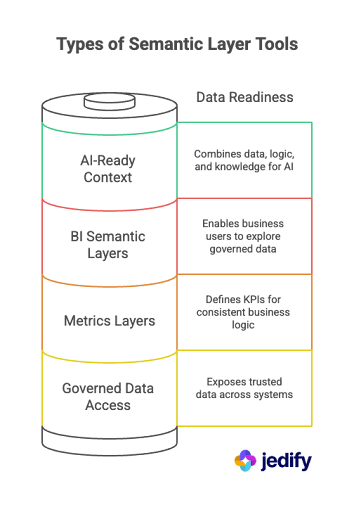
There are several types of semantic layer tools:
- Metrics layers: Define KPIs, dimensions, joins, and calculations to ensure analytics teams use consistent business logic across BI tools, dashboards, and downstream applications.
- BI semantic layers: Sit inside analytics platforms and help business users explore governed data through dashboards, reports, self-service analytics, and natural-language interfaces.
- Governed data access layers: Use virtualization, federation, data products, or lakehouse abstractions to expose trusted data across distributed systems without forcing every team to work directly with raw sources.
- AI-ready context layers: Combine operational data, BI/reporting logic, and business knowledge so AI agents and AI apps can reason with business context, not just query raw tables or schemas.
Top Picks at a Glance
- Recommended for AI-ready semantic context: Jedify
- Recommended for a headless metrics layer: Cube
- Recommended for dbt-centric metric governance: dbt Semantic Layer
- Recommended for BI-native semantic modeling: Holistics
- Recommended for governed data access across distributed sources: Denodo
15 Top Semantic Layer Tools
Category 1: AI-Ready Context and Semantic Infrastructure
| Tool | Best for | Type | AI ready | Setup |
|---|---|---|---|---|
| Jedify | Governed business context for AI agents | AI-ready context layer | High | Medium |
| Promethium | Self-service answers across distributed data | AI-ready data fabric | High | Medium–high |
1. Jedify
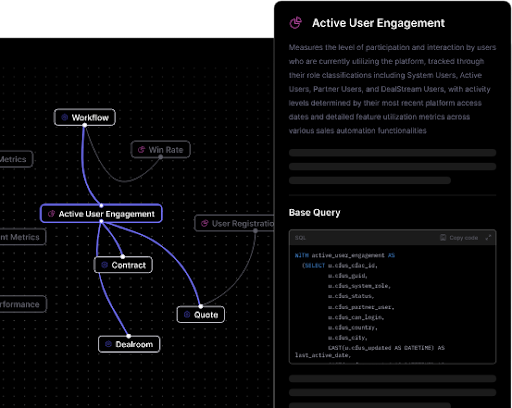
Jedify is a contextual data platform for AI agents. Jedify connects to your data stack and business knowledge, then turns fragmented business data, BI logic, and knowledge into a shared context layer that AI agents can use accurately.
Jedify’s core capability is Semantic Fusion™, a living semantic layer that fuses operational data, BI and reporting logic, and business knowledge into a governed context graph. It stays current as connected sources, schemas, and business definitions evolve.
This makes Jedify a strong fit for enterprises where the challenge is not only defining metrics, but giving agents the broader business context they need to reason across domains. That context may include warehouse data, CRM data, dashboards, BI/reporting logic, documents, spreadsheets, catalogs, URLs, and business definitions.
Main features:
- Semantic Fusion™ context graph
- AI-ready semantic context layer
- Connectors across enterprise data, BI tools, and business knowledge
- Native agents for natural-language analytics and investigation
- Contextual MCP server for external agents and AI apps
- Governance and semantic controls for review, refinement, and consistency
Pricing: By inquiry.
Recommended for: Data and AI teams building enterprise agents or AI apps that need governed business context, not just access to data.
2. Promethium

Promethium provides an AI-ready data fabric for self-service analytics across distributed enterprise data. Its Instant Data Fabric and Mantra Data Answer Agent are positioned around trusted, contextual answers without duplicating data or forcing teams into a single platform stack.
Main features:
- Instant Data Fabric
- Mantra Data Answer Agent
- 360° Context Engine
- Trusted contextual data answers
- Integration across distributed data platforms and enterprise tools
Pricing: By inquiry.
Recommended for: Enterprises that need self-service answers across distributed data without duplicating pipelines or centralizing every source first.
Category 2: BI and Metrics Semantic Layer Tools
| Tool | Best for | Type | AI ready | Setup |
|---|---|---|---|---|
| Cube | Headless metrics and analytics APIs | Metrics / universal semantic layer | High | Medium |
| dbt Semantic Layer | Metric consistency in dbt projects | Metrics layer | Medium–high | Medium |
| Holistics | Analytics-as-code BI and governed self-service analytics | BI semantic layer | Medium–high | Medium |
| Omni | AI-assisted BI on a semantic model | BI semantic layer | Medium–high | Medium |
| Rill Metrics SQL | SQL-based metrics for humans and agents | Metrics layer | Medium–high | Medium |
| Lightdash | dbt-native BI and governed metrics | BI / metrics layer | Medium | Low–medium |
| Zenlytic | Conversational analytics with modeled metrics | AI BI semantic layer | Medium | Low–medium |
| AtScale | Universal metrics across BI and AI tools | Universal semantic layer | High | High |
| ThoughtSpot Spotter Semantics | Agentic BI with governed context | Agentic BI semantic layer | High | Medium–high |
3. Cube

Cube is a universal semantic layer and agentic analytics platform. It supports semantic modeling, analytics APIs, embedded analytics, caching, query performance, and AI-oriented analytics workflows.
Main features:
- Universal semantic layer
- Metrics and data modeling
- APIs for embedded analytics
- Caching and query acceleration
- Semantic model agent and analytics chat
- Downstream semantic layer sync
Pricing: Cube offers a free plan, Starter at $40 per developer/month, and Premium at $80 per developer/month, with custom enterprise pricing.
Recommended for: Teams that want a reusable semantic layer to power BI, embedded analytics, and AI-facing analytics experiences.
4. dbt Semantic Layer
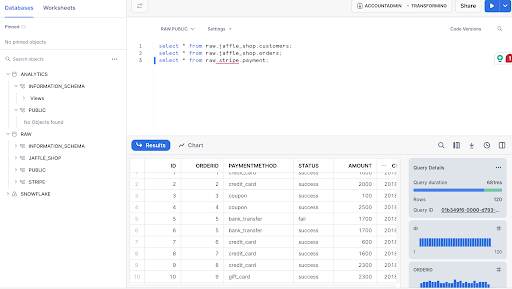
The dbt Semantic Layer, powered by MetricFlow, enables data teams to define critical business metrics within the dbt modelling layer. dbt says centralizing metric definitions helps teams provide consistent self-service access to metrics across downstream tools and applications.
Main features:
- MetricFlow-powered semantic layer
- Centralized metric definitions
- Semantic models and metrics in dbt
- Downstream tool access to governed metrics
- Access permissions and governance controls
Pricing: dbt’s Starter plan is listed at $100 per user/month and includes dbt Semantic Layer basic, with custom enterprise options available.
Recommended for: Analytics engineering teams that already use dbt and want governed metrics across BI and downstream applications.
5. Holistics
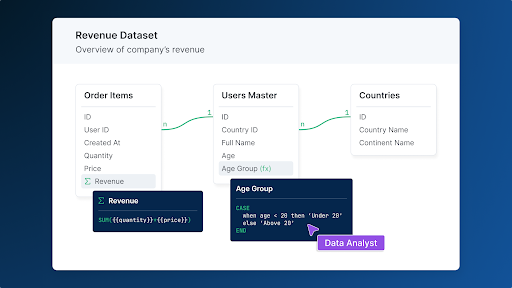
Holistics is an AI analytics and self-service BI platform built around a programmable semantic layer. Its semantic model uses AML, while AQL provides a composable query language for metrics on top of that model. Holistics positions this as a governed layer in which AI and human users reason using the same business logic.
Main features:
- Programmable semantic layer using AML
- AQL for composable metric queries
- Analytics-as-code workflows
- Version-controlled business logic
- Dashboards, explorations, and self-service BI
- AI-assisted analytics grounded in the semantic layer
Pricing: By inquiry.
Recommended for: Data teams that want a lesser-known BI-native semantic layer with analytics-as-code, governed metrics, and AI-assisted self-service analytics.
6. Omni

Omni is an AI analytics and BI platform built around a semantic model. Omni positions the semantic model as central to its support for AI-assisted analytics, self-service reporting, dashboards, and governed exploration.
Main features:
- BI platform with semantic modeling
- AI chat for analytics
- Dashboards and self-service reporting
- Governed data exploration
- Embedded analytics support
Pricing: By inquiry.
Recommended for: Teams that want a modern BI platform where the semantic model supports both self-service analytics and AI-assisted workflows.
7. Rill Metrics SQL

Rill Metrics SQL is a SQL-based semantic layer for metrics. Rill’s approach treats metrics such as revenue, MAU, and ROAS as core primitives and makes the semantic layer queryable through SQL rather than a proprietary language or API.
Main features:
- Metrics SQL
- SQL-based semantic layer
- Metrics-first data modeling
- Dashboards, reports, and alerts
- AI token and API quotas in Rill Cloud
Pricing: By inquiry.
Recommended for: Teams that want a metrics layer based on SQL rather than custom semantic-layer syntax.
8. Lightdash
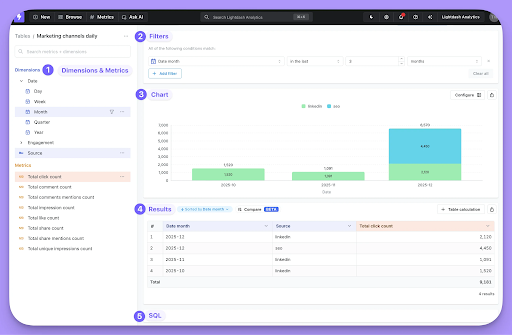
Lightdash is an open-source, dbt-native BI platform. It connects to dbt projects, helps teams define metrics once, and runs queries through a governed semantic layer to keep results consistent.
Main features:
- Open-source BI platform
- Native dbt integration
- Governed semantic layer
- Dashboards and reports as code
- AI agents for dashboards and analytics workflows
Pricing: Lightdash offers a self-hosted open-source option and Cloud Pro at $3,000/month with unlimited users and native dbt integration.
Recommended for: dbt-centric teams that want open-source BI with governed metrics and no per-seat pricing.
9. Zenlytic
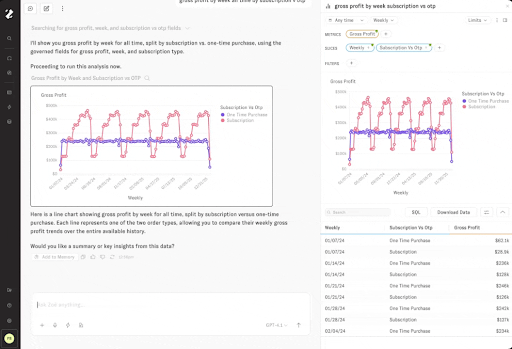
Zenlytic is an AI data analyst and BI platform built around Zoë, its conversational analytics interface. Its documentation describes a cognitive layer that lets data teams model company metrics such as revenue or conversion so they can be used consistently across the organization.
Main features:
- Zoë AI data analyst
- Conversational analytics
- Cognitive semantic layer
- Metric modeling
- Integrations with common warehouses and BI/data tools
- MCP and data model workflows
Pricing: By inquiry.
Recommended for: Organizations that want an AI analyst experience backed by modeled metrics and governed business definitions.
10. AtScale

AtScale provides a universal semantic layer for enterprise analytics and AI. It defines metrics, relationships, and business logic once, then exposes them consistently to BI tools, analytical applications, LLMs, and autonomous agents.
Main features:
- Universal semantic layer
- Metrics and dimension modeling
- BI tool interoperability
- LLM and autonomous agent support
- Deployed semantic objects
- Enterprise governance and access controls
Pricing: By inquiry.
Recommended for: Large organizations that need governed metric consistency across BI, analytics applications, and AI systems.
11. ThoughtSpot Spotter Semantics
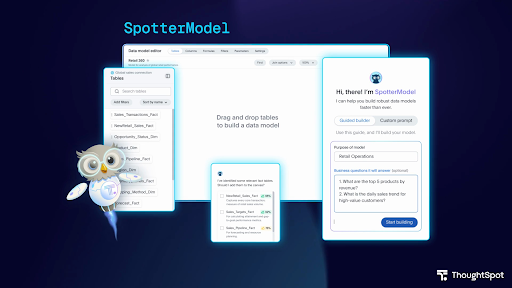
ThoughtSpot Spotter Semantics is an agentic semantic layer that brings governed business context into AI-powered analytics. ThoughtSpot says Spotter Semantics connects to agentic systems via its MCP server and Open Semantic Interchange, enabling governed context to flow across AI agents, LLMs, and data platforms.
Main features:
- Spotter Semantics
- Agentic BI workflows
- MCP server
- Open Semantic Interchange
- Search tokens and aggregate awareness
- Governed analytics context
Pricing: By inquiry.
Recommended for: Enterprises that want agentic BI with governed semantic context across analytics and AI interfaces.
Category 3: Warehouse, Lakehouse, and Governed Data Access Layers
| Tool | Best for | Type | AI ready | Setup |
|---|---|---|---|---|
| Snowflake Semantic Views / Cortex Analyst | Snowflake-native semantic modeling | Warehouse-native semantic layer | Medium–high | Medium |
| Denodo AI SDK | Governed data virtualization for AI apps | Data access / virtualization layer | High | High |
| Starburst Data Products / AIDA | Federated data products for BI and AI | Governed access / context layer | High | High |
| Dremio Universal Semantic Layer | Lakehouse semantic access | Lakehouse semantic layer | Medium–high | Medium |
12. Snowflake Semantic Views / Cortex Analyst

Snowflake Semantic Views and Cortex Analyst provide a Snowflake-native way to define semantic models for natural-language analytics. Snowflake recommends Semantic Views for new Cortex Analyst implementations, with support for derived metrics, access modifiers, custom instructions, and Snowflake governance features such as RBAC and privilege management.
Main features:
- Snowflake Semantic Views
- Cortex Analyst
- Derived metrics
- Public/private metric controls
- Custom SQL-generation instructions
- Native Snowflake access controls
Pricing: By inquiry.
Recommended for: Snowflake-first teams that want warehouse-native semantic modeling for natural-language analytics.
13. Denodo AI SDK
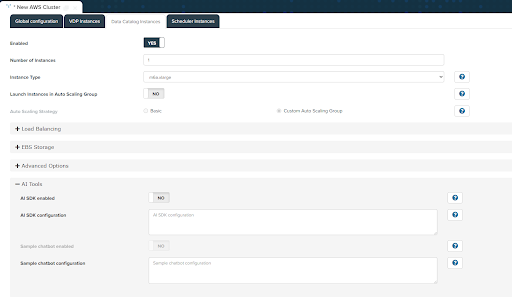
Denodo’s AI SDK provides a governed interface for AI applications to access and combine data through the Denodo Platform. Denodo says the SDK abstracts the complexity of connecting, transforming, and merging data while preparing information enriched with technical and business metadata for AI model consumption.
Main features:
- AI SDK
- Governed data virtualization
- Metadata-enriched AI access
- APIs for AI application development
- Data access across multiple sources
- Security and governance through Denodo Platform
Pricing: By inquiry.
Recommended for: Enterprises that need governed, virtualized data access for AI apps and analytics across distributed systems.
14. Starburst Data Products / AIDA

Starburst provides federated access across cloud, lake, warehouse, streaming, and SaaS sources. Its platform includes an enterprise context layer, data products, and AIDA, an AI data assistant and agentic control plane.
Main features:
- Federated query across distributed sources
- Enterprise context layer
- Data products with ownership and policies
- AIDA AI data assistant
- MCP query endpoint
- Governance and workload controls
Pricing: Starburst offers a 30-day free trial with $500 in Starburst Galaxy compute resources, then a free tier with limited clusters.
Recommended for: Enterprises that need governed access to distributed data products for analytics, BI, and AI agents.
15. Dremio Universal Semantic Layer
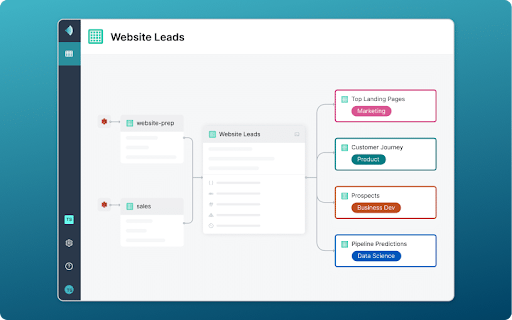
Dremio’s Universal Semantic Layer provides governed access across lakehouse data and other sources. Dremio describes it as a semantic data layer that lets teams curate virtual datasets, define business-friendly metadata, and apply centralized governance without unnecessary data movement.
Main features:
- Universal Semantic Layer
- Virtual datasets and data marts
- Business and technical metadata
- Dataset labels and discovery
- Centralized governance
- Lakehouse query acceleration
Pricing: Dremio Cloud pricing is usage-based, with pay-as-you-go listed at $0.20 per Dremio Compute Unit. Dremio also offers a 30-day free trial with $400 in credits.
Recommended for: Teams building governed lakehouse analytics and semantic access across open data architectures.
How We Compared These Tools
We compared these semantic layer tools using publicly available information, including vendor documentation, product pages, pricing pages, implementation guides, and credible third-party reviews where relevant. We did not run hands-on tests for every product.
We grouped the tools into three categories because they solve different semantic layer problems. AI-ready context and semantic infrastructure tools were assessed for their ability to combine structured data, BI logic, business knowledge, and agent-facing delivery. BI and metrics semantic layer tools were assessed for metric governance, modeling depth, BI interoperability, and dashboard consistency. Warehouse, lakehouse, and governed data access layers were assessed for abstraction, federation, access control, and governed data delivery.
For each tool, we reviewed semantic layer type, AI agent readiness, governance model, setup effort, and best-fit use case. For production use cases, teams should also evaluate AI agent security, including identity controls, permission boundaries, auditability, and how governed context is exposed to external agents.
Build a Semantic Layer That Matches the Way AI Actually Works
Semantic layer tools help you move from fragmented data logic to governed, reusable business meaning. For AI teams, the requirement is broader. Agents need more than schemas, metric names, or SQL access. They need business context: how the company defines its entities, how reporting logic works, how teams interpret performance, and how operational knowledge connects across systems.
That is where the category is moving. Traditional semantic layers still matter, but AI-ready semantic infrastructure needs to combine enterprise data, BI logic, and business knowledge into a governed context layer that agents and AI apps can use reliably.
Jedify is a contextual data platform for AI agents built for this broader requirement. Its Semantic Fusion™ engine turns fragmented operational data, BI and reporting logic, and business knowledge into a living, governed semantic context layer that agents and AI apps can reuse. This capability keeps definitions consistent as the business changes and gives teams a shared context foundation for analytics and agent deployment.
To see how Jedify helps agents reason with business context, book a demo.
![13 Best Customer Data Platforms for Retail [By Industry Segment]](https://jedify.com/wp-content/uploads/retail_cdp_hero.svg)