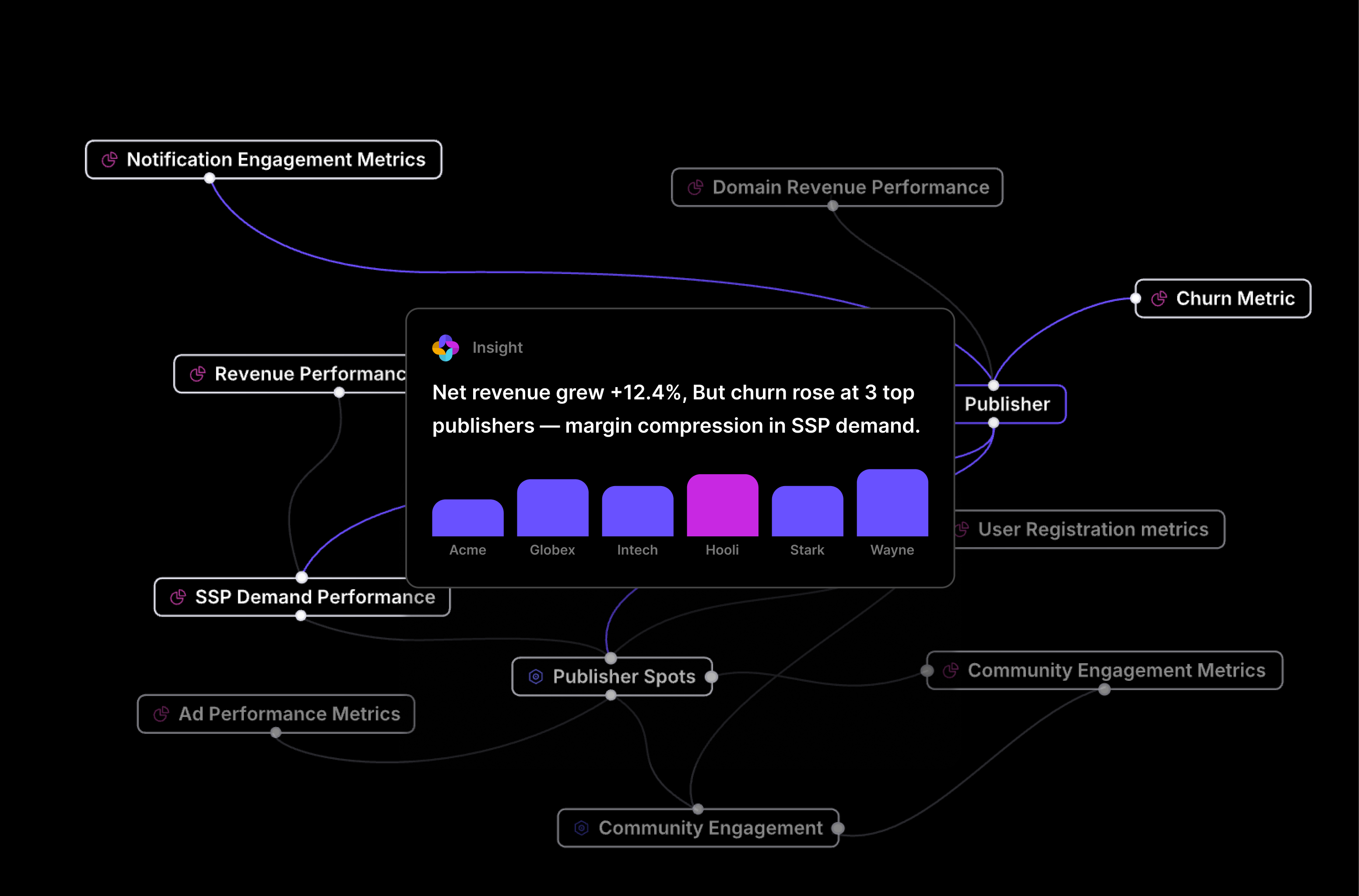


Your organization already knows how it talks about the business. You know what “Active User” means, when the week starts, and what are the code names for your top products. Until now, that knowledge lived in docs, dashboards, and people’s heads. This is typically called your “institutional” or “tribal” knowledge. Semantic Statements brings it into Jedify, so your agent understands your domain, speaks your terms, and returns answers that match how you measure the business.
If you’ve ever watched two teams spend a week reconciling the “same” metric – or lost time to “does our week start on Sunday or Monday?” – you know why this matters. Semantic Statements turn those hallway definitions into explicit, governed, reusable logic your agent respects on every question.
Why data teams will love this
This is a natural extension of the automatic generation of the Semantic Fusion™ that creates a connection (or fuses) between your organization’s data to your business context and terminology.
To get the most value, upload documents for automatic conversion into statements or write your own. You can also use some of the pre-set settings for commonly used customization related to time, dates, currency and formatting.
Semantic Statements is built for data experts who own definitions, standards, and guardrails. Encode the language and logic of your organization directly into Jedify once, and every PM, analyst, and executive benefits on every question.
- Consistent answers: One place to define official meanings for business terms.
- Fewer “what does X mean?” Slack threads and fewer ad-hoc “data doctor” requests.
- Language aware: Map the team lingo and legacy terms to standard definitions.
- Natural questions land on the right metric without redesigning how people talk.
- Time that matches reality: Align queries to fiscal calendars, rolling windows, and cohort anchors you actually use.
- No more apples-to-oranges trends in exec readouts.
- Trustworthy guidance: Align on settings across the business with maximum control.
- Answers that are presentation-ready and consistent with how you communicate.
What does this mean? Teams move faster with fewer review cycles, and stakeholders build trust because the agent answers like your business actually operates.
What’s inside
Four statement types you can mix and match:
- Business Glossary
A governed, organized dictionary of your company’s terms, metrics, and rules that gives Jedify’s agentic AI the context to understand your language and answer domain-specific questions with precision. - Synonyms
Language mapping, for example “customers” equals “users” and “GMV” maps to “Revenue,” so natural questions land on the right entities. - Time Analysis
Rules for fiscal calendars, week starts, rolling windows (7, 28, 90 days), and cohort anchors. No more apples to oranges trends. - Answer Guidance
Presentation and response-formatting rules for Jedify’s agentic AI. Set date and number formats and custom display preferences so answers align with your communication standards and user expectations.
All statements are reviewable and versioned, giving you governance without slowing teams down.
Get started in minutes
Go to Settings → Semantic Statements and add:
- Your top business terms
- Common synonyms and legacy labels
- Two or three time rules such as fiscal week, rolling windows, and cohort anchor
- One or two guidance such as formatting or response style
Pro tip from the field: start with the 10–15 terms that trigger the most debates or rework, then expand. You’ll see impact immediately without a heavy lift.
▶️ Watch this demo to see the flow end to end.
Ready to make every answer speak your business?
Capture your language once with Semantic Statements, and give every user a tailored, trustworthy Jedify experience.
Make the implicit explicit so everyone uses the same definitions, and you spend less time fixing mismatched numbers.