Abstract
Enterprise AI is moving past the experimental phase, but the biggest bottleneck remains the data itself. To build highly useful agents, you need more than a generic model; you need a dedicated AI data platform stack. This article explores the top platforms that standardize definitions across agents and apps and allow teams to scale autonomous systems without the usual infrastructure friction.
The Top AI Data Platforms for 2026
- Jedify
- Cube
- AtScale
- Lightdash
- TextQL
- Apache Gravitino
- OpenMetadata
- lakeFS
- Unstructured
- Estuary Flow
- Apache SeaTunnel
- Airbyte
We’ve reached a point where the AI market is segmented into distinct layers for data movement, governance, and context. For most data leaders, this fragmentation makes selecting a vendor feel like a gamble.
Current Gartner forecasts show that 60% of AI projects will be abandoned this year simply because the underlying data isn’t ready. This usually boils down to data debt, brittle pipelines, and poorly defined processes, leading to unreliable outputs. Without a system that delivers governed, real-time context, most AI projects are destined to fail the moment they face real-world users.
This guide is designed to help you navigate the current market without the usual headache. We’ve identified the top platforms for each layer of the AI stack and provided a consistent framework to vet them. Understanding how these tools actually fit together will help you select a foundation that turns your enterprise data into a genuine asset rather than a liability.
What are AI data platforms?
An AI data platform is the set of systems that turns fragmented enterprise data and business definitions into an AI-ready context. These platforms help agents, AI apps, and multi-agent AI systems consistently and securely answer questions.
An AI data platform is no longer one product. It’s a stack of layers that handle movement, governance, and semantic context across structured systems and unstructured knowledge. The goal is to make it usable by AI without inventing logic or drifting from how the business measures itself.
These platforms exist because most enterprise AI fails at the same bottleneck. Definitions and logic are scattered across BI models, dashboards, dbt projects, and tribal knowledge. If agents don’t share a governed context layer, you get shadow logic where different apps compute the same metric differently.
AI data platforms are typically used by data and AI leaders who need production-grade agentic analytics, reliable AI apps, and a scalable way to reuse governed definitions across teams and use cases.

Top Picks at a Glance
- Recommended for contextual data platforms for AI agents: Jedify
- Recommended for semantic and metrics layers: Cube
- Recommended for governance, metadata, and data versioning: OpenMetadata
- Recommended for data movement and AI/ML readiness: Airbyte
Comparison Table: Best AI Data Platforms Compared
| Tool | Best for | Key strength | Pricing (starting) | Setup effort |
| Jedify | AI agents needing shared context | Fuses data + BI logic + docs | Custom (enterprise) | Med |
| Cube | Governed metrics for BI + AI | Universal semantic API | Free (OSS); paid cloud | Med |
| AtScale | Enterprise semantic virtualization | Strong governance + scale | By inquiry | High |
| Lightdash | dbt-native teams | dbt metrics + exploration | Free (OSS); paid cloud | Med |
| TextQL | NL → governed analytics | Ontology + semantic mapping | Free; Team from $250/mo | Low–Med |
| Apache Gravitino | Multi-engine metadata control | Federated metadata layer | Free (OSS) | High |
| OpenMetadata | Catalog + lineage + governance | Strong metadata graph | Free (OSS); managed tiers | Med |
| lakeFS | Reproducible AI/ML datasets | Data versioning + rollback | Free (OSS); enterprise | Med |
| Unstructured | Doc → RAG ingestion | Layout-aware parsing | Free (OSS); API usage | Low |
| Estuary Flow | Real-time data sync | CDC + low-latency pipelines | From $0.75/GB | Med |
| Apache SeaTunnel | Massive data movement | High-perf integration | Free (OSS) | High |
| Airbyte | Broad ELT connectors | Huge connector library | Free (OSS); usage-based | Low–Med |
| Feast | Predictive ML features | Online/offline feature store | Free (OSS) | High |
12 Top AI Data Platforms For 2026
Category 1: Contextual Data Platform for AI Agents
1. Jedify

Jedify is a Semantic Fusion™ platform that turns fragmented enterprise data and business knowledge into an AI-ready context layer for agents, analysts, and applications. Instead of forcing teams to rebuild business logic inside every AI app, Jedify learns from existing data sources, BI tools, dashboards, documentation, and catalogs to create a governed semantic knowledge graph.
It acts as a governed semantic context layer that fuses operational data, BI logic, and business knowledge into reusable data context for AI agents and AI apps.
Main Features:
- Semantic Fusion™: Creates an AI-ready semantic knowledge graph by fusing structured data, unstructured knowledge, BI logic, and business context.
- BI Logic Ingestion: Learns from existing dashboards, metrics, documentation, and systems of record so agents can reuse trusted business definitions instead of inventing their own.
- Contextual MCP Server: Streams governed context from the Semantic Fusion™ model into AI agents and applications on the platforms teams already use.
Best For: Companies building AI agents, agentic analytics, or AI-powered data apps that need consistent business context across metrics, systems, and workflows.
Price: Custom enterprise pricing; available via AWS and Snowflake marketplaces.
Category 2: Semantic and Metics Layers
2. Cube

Cube is a universal semantic layer that acts as the antidote to AI hallucinations and provides a standardized API for your data, ensuring that whether a human or an AI asks for a metric, the answer is identical.
At its core, Cube uses a data modeling language based on YAML or JavaScript to define “Cubes.” Each Cube represents a business entity, such as a customer, an order, or a subscription, and contains the specific logic for its measures and dimensions.
Main Features:
- Semantic Document Loader: A feature that populates vector databases with embeddings derived directly from your governed data models.
- Caching & Pre-aggregation: Ensures that complex AI queries don’t crash your warehouse or take minutes to resolve.
Best For: Data engineering teams that need a single and trusted source of truth for both internal dashboards and external-facing AI agents.
Price: Usage-based (CCU); free OSS option.
3. AtScale
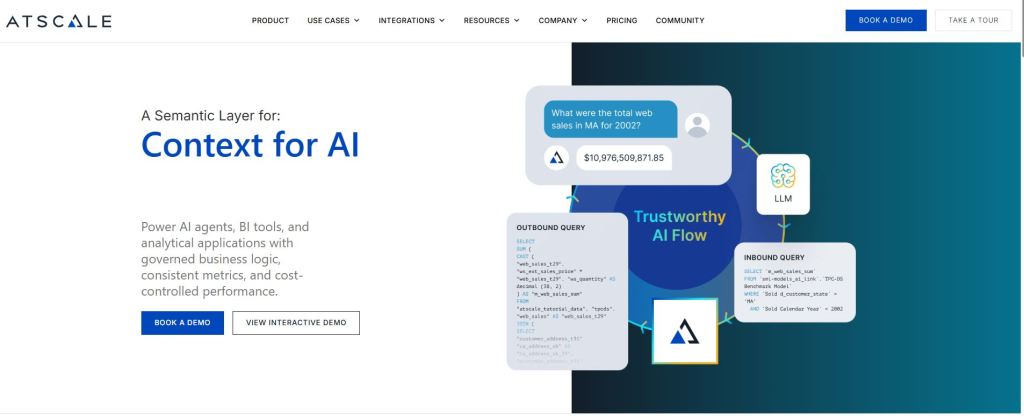
AtScale provides an enterprise-grade semantic layer that abstracts away the complexity of cloud data warehouses like Snowflake and BigQuery, presenting them as a simplified business interface for AI.
AtScale uses a design once, query anywhere approach. Instead of writing rigid ETL pipelines to create flattened tables for AI consumption, you build a virtual business model. This model defines the relationships between disparate data points across your warehouse.
Main Features:
- Deterministic Semantic Governance: Ensures AI results are based on hard-coded business logic rather than probabilistic LLM guesses.
- Versioned Model Control: Tracks every change in your data definitions, providing a full audit trail for explainable AI and GRC automation workflows.
Best For: Large enterprises with massive, complex data architectures that need to expose a simplified, governed view of their data to both human analysts and autonomous AI systems.
Price: Custom enterprise pricing.
4. Lightdash

Lightdash is a BI and semantic layer built specifically for the modern data stack. It turns your DBT (data build tool) transformations into an interactive exploration layer. Lightdash has evolved from a standard BI tool into an Agentic BI platform. This move focuses on making governed data accessible to autonomous systems.
Main Features:
- dbt-Native Modeling: Every metric defined in your dbt code is automatically exposed to the Lightdash UI and its AI connectors.
- Verified Assets: A tagging system that tells AI agents which tables and charts have been “human-approved.”
Best For: Data teams already heavily invested in dbt who want to enable self-service AI analytics.
Price: Free OSS; Cloud plans available.
5. TextQL
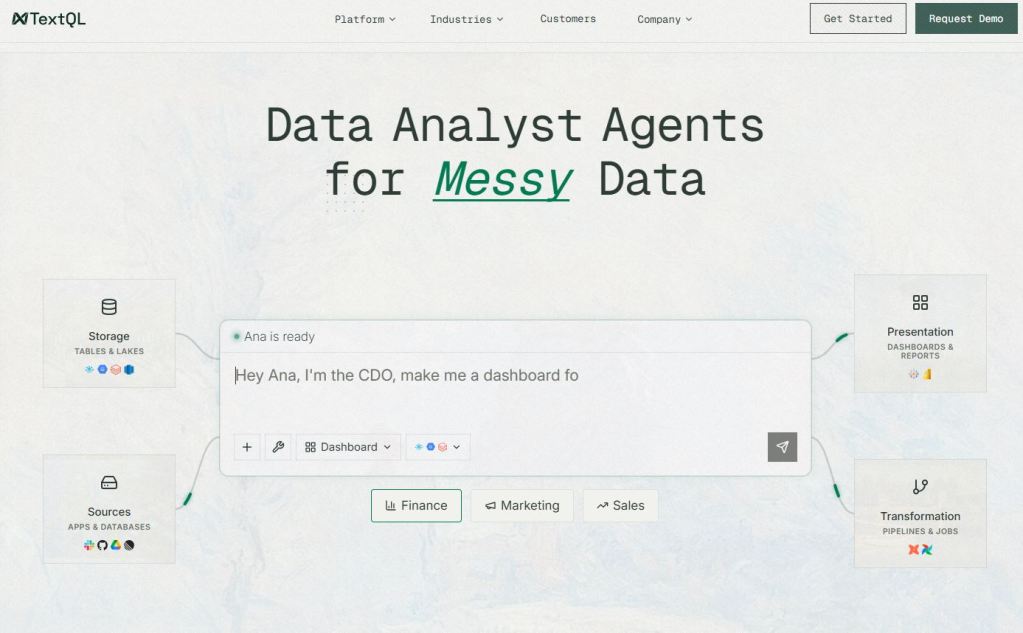
TextQL solves the problem of “black box” data access. Connecting directly to your catalogs and BI tools, it gives AI agents a roadmap for your internal data structures.
Rather than just being another search bar, it integrates directly with your existing semantic layers, like dbt or Cube, to map ambiguous business questions to precise, governed data queries.
Main Features:
- Ontology Builder: A tool that maps ambiguous business terms (e.g., churn) to the specific columns and logic required to calculate them.
- Conversation Memory: Allows the platform to retain context across a long analytical session.
Best For: Organizations looking to automate the “ad-hoc request” queue for their data team.
Price: Analyst tier is free; Team tier starts at $250/month.
Category 3: Governance, Metadata, and Data Versioning
6. Apache Gravitino
Gravitino is a metadata lake that acts as a universal control plane. It unifies your catalogs across silos and geo-locations into a single searchable interface. In the 2026 AI ecosystem, it is a critical piece of infrastructure for organizations that need to manage data gravity while feeding disparate datasets into a centralized AI model.
Main Features:
- Table Maintenance Service (TMS): Automatically manages table health (compaction, cleanup) so AI query engines stay fast.
- Scan Planning Offload: Reduces query latency by handling the metadata “heavy lifting” for engines like Spark and DuckDB.
Best For: Multi-cloud enterprises managing a mix of SQL databases, Iceberg tables, and object storage.
Price: Free (Open Source).
7. OpenMetadata

OpenMetadata is a centralized platform for data discovery, governance, and quality, built on a unified metadata standard. This platform is built on a schema-first philosophy rather than just being a reactive list of tables.
OpenMetadata uses a massive library of 700+ JSON schemas to standardize everything. This creates a reliable, predictable vocabulary for your entire data estate.
Main Features:
- Knowledge Graph: A visual map showing how business terms connect to technical data, which AI agents use for reasoning.
- AI Analytics: A native assistant that translates natural language into governed charts grounded in your metadata.
Best For: Teams that need to track data lineage and ownership while supporting governed AI workflows, discovery, and data mining.
Price: Free, open-source; Managed tiers start at $500/month.
8. lakeFS
lakeFS moves data management out of the “hope for the best” phase by adding version control to S3 and other cloud buckets. By treating your data as code, you can branch off for new AI models and only merge back when you’re sure the data is clean.
It is the most reliable way to maintain a reproducible and safe AI stack. The most critical feature of lakeFS is its ability to create isolated versions of your data lake through zero-copy branching.
Main Features:
- Zero-Copy Branching: Create a sandbox of a petabyte-scale data lake instantly without actually duplicating the files.
- Data Rollbacks: If an AI model is trained on bad data, you can revert the entire dataset to a previous commit state.
Best For: ML engineers who require 100% reproducibility in their training sets.
Price: Free, open-source; Enterprise Cloud available.
Category 4: Data Movement and AI/ML Readiness Layers
9. Unstructured
Unstructured provides the ETL pipelines needed to crack those files open for RAG and agentic workflows.
The platform’s standout capability is its Generative Document Parsing. Unlike traditional OCR, which simply scrapes text into a wall of words, Unstructured uses layout-aware models to recognize a document’s structural intent.
Main Features:
- Automated Partitioning: Recognizes the difference between a title, a table, and a footer in a PDF to preserve context.
- Cleaning Bricks: Pre-built functions to remove boilerplate text, emails, and signatures that clutter AI prompts.
Best For: Anyone building a RAG system that relies on a library of varied document formats.
Price: Free OSS; API pricing starts around $1 per 1,000 pages (pipeline-dependent).
10. Estuary Flow
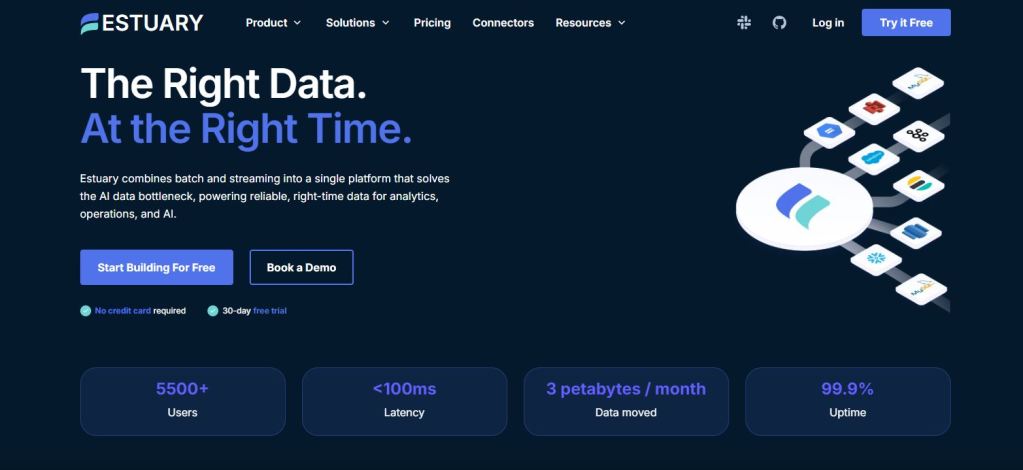
Estuary Flow replaces the need for a fragmented integration stack. By combining real-time CDC with traditional batch movement, it creates a unified path for your data to travel and, for AI applications that rely on fresh information, provides a reliable, low-latency pipeline that keeps your vector stores or warehouses perfectly in sync with your production systems.
Built on top of the open-source Gazette streaming framework, Flow is designed to move data from any source to any destination with sub-second latency, without the operational complexity typically associated with Kafka-based systems.
Main Features:
- Exactly-Once Semantics: Ensures data is never duplicated or lost during transit—critical for financial AI applications.
- Sub-Second Latency: Moves data from a database to an AI vector store in under a second.
Best For: Real-time AI needs, such as fraud detection or live customer support.
Price: Pay-as-you-go; calculator on pricing page.
11. Apache SeaTunnel
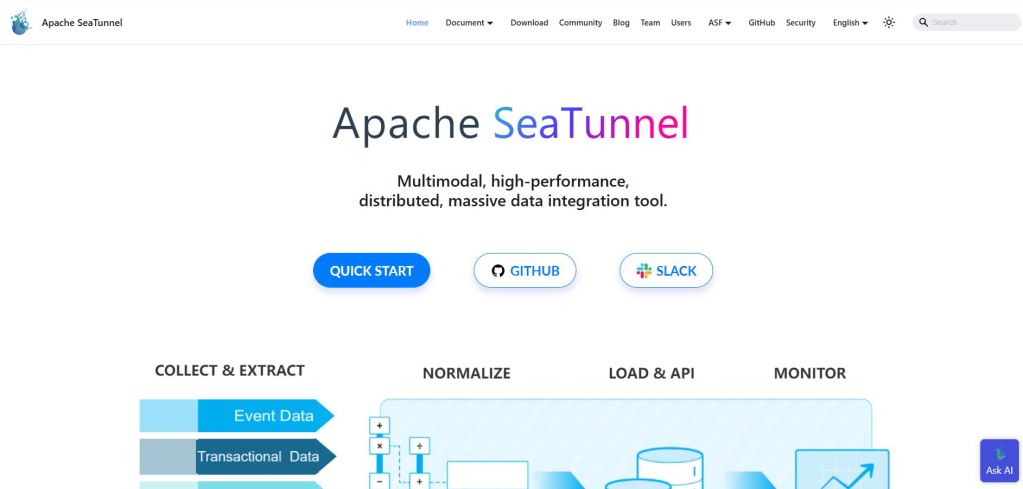
Apache SeaTunnel is an ultra-high-performance, distributed data integration platform designed to synchronize hundreds of billions of records daily. In the AI landscape, it has emerged as a preferred alternative to heavyweight frameworks like Spark or Flink for teams that need to move massive datasets without the engineering tax of complex cluster management.
Main Features:
- Zeta Engine: A specialized execution engine that is faster and more stable than Spark for simple data movement.
- Schema Evolution: Automatically detects and applies changes to your data structure as it moves.
Best For: Engineering teams moving massive “Big Data” volumes between 100+ different sources and sinks. Skip it for low-volume SaaS-to-Warehouse syncing.
Price: Free (Open Source).
12. Airbyte
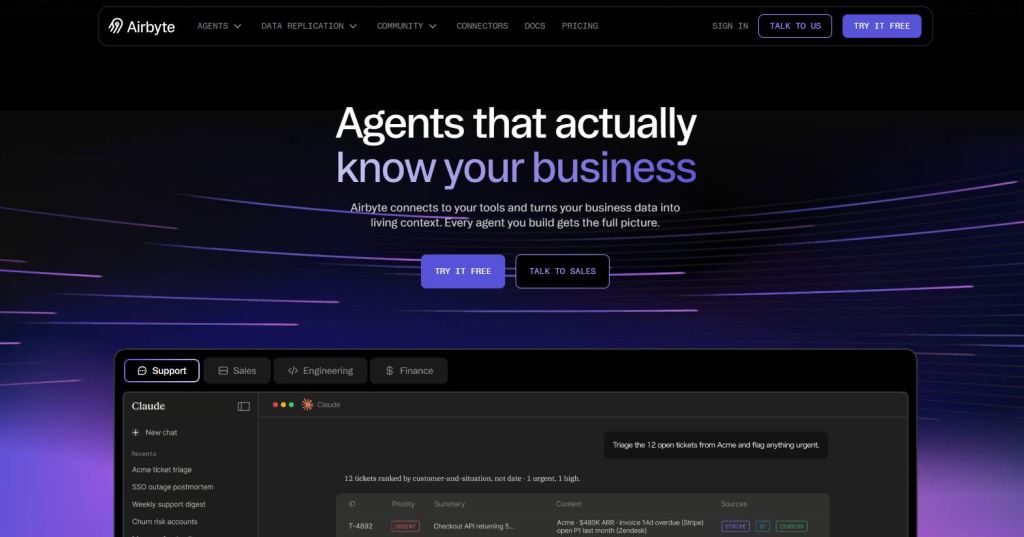
Airbyte is a self-hosted or managed integration engine that standardises data extraction via a unified specification. It uses a source-destination model to pull from 600+ APIs and databases, handling the authentication, rate-limiting, and state management for each.
Main Features:
- Context Store: A live, searchable index of your entire business (CRM, tickets, conversations) that agents can query via a single API.
- 600+ Connectors: The largest library of pre-built integrations in the world.
Best For: Teams building Generalist Agents that need to pull info from dozens of SaaS tools like Salesforce, Slack, and Zendesk. This is a pattern that can quickly create an agentic identity crisis if permissions are too broad.
Price: Free open source; Cloud is volume-based (Pay-As-You-Go).
How We Compared These Tools
We evaluated each platform using the same criteria so you can shortlist options quickly. This review is based on publicly available information as of May 2026, including technical specs and official changelogs.
We narrowed down this year’s leaders by looking at the three things that matter most for enterprise AI: integration depth, roadmap reliability, and cost-to-scale. This involved a deep dive into:
- Official documentation, feature pages, and implementation guides
- Pricing pages and plan limits (or packaging notes where pricing isn’t public)
- Release notes / changelogs (where available)
- Security and compliance materials, including how platforms help teams prepare for AI-driven attacks and emerging model-powered risks
- Third-party reviews (e.g., G2, Capterra) and credible independent comparisons
Please note that we did not perform hands-on testing for every tool, and if a specific capability was not clearly documented or user reviews were conflicting, we avoided making definitive claims and highlighted the uncertainty in the tool profile.
Why Shared Context Is the Future of AI
AI projects stall because of logic sprawl. If individual agents interpret raw tables on their own, you get shadow logic where different bots calculate the same metric in different ways. The fix is to move business logic out of agent configurations and into a shared semantic layer, so when a schema changes, you update the logic once instead of chasing down every broken workflow.
Jedify exemplifies this shift by acting as an AI data platform for shared, governed business context. Sitting above your lake or warehouse, it helps prevent semantic drift by fusing enterprise data with BI definitions and internal knowledge into a context layer your team can review and govern. The same definitions can then power a fleet of agents and applications, helping teams roll out AI systems faster, reduce regressions, and build more trust in AI-generated outputs.
See how Jedify turns enterprise data into governed AI context by booking a demo.