Abstarct
Top Data Mining Tools Include:
- Jedify
- KNIME Analytics Platform
- Orange Data Mining
- Weka
- ELKI
- Analytic Solver Data Mining
- KoBold Metals
- Slingshot Aerospace
- GoMetro
- Dataiku
- Alteryx
- BigML
- TIBCO Statistica
- Minitab SPM
- Altair AI Studio
- H2O.ai
Definitions break before models do. Most teams already have a BI stack and a growing set of ML and AI tools, yet results still drift, and agents produce answers nobody trusts.
The problem is that the business meaning behind the data is fragmented. That fragmentation is now showing up as real delivery risk: 42% of enterprises say more than half of their AI projects have been delayed, underperformed, or failed due to data readiness issues.
This guide breaks down the best data mining tools by category so you can shortlist the right fit.
What are data mining tools?
Data mining tools help you find patterns and build predictive or segmentation models from data at scale. They combine capabilities such as data preparation, feature engineering, statistical analysis, anomaly detection, and model evaluation.
The goal of data mining tools is to help teams move from “what happened?” to “what’s driving it, and what’s likely next?” without stitching together a dozen scripts for every new question.
They’re especially useful when manual analysis and standard BI fall short. For example, when spotting the hidden drivers of churn across dozens of attributes or predicting pipeline risk based on historical deal traits. Data context is the business meaning that keeps those insights consistent when they’re reused.
The output is typically models, segments, rules, and ranked drivers you can operationalize in workflows, apps, or analytics. Data and AI teams primarily use data mining tools, but these solutions are also valuable for product analytics, RevOps, risk, fraud, and ops teams that need repeatable pattern discovery and predictive analysis.
Data Mining Tools vs BI Dashboards vs Context Layers
It’s worth differentiating data mining tools from general BI dashboard tools and data warehouses or lakes. Where dashboards report on predefined metrics, and warehouses and lakes store data, mining tools analyze it to discover drivers and build models. That gap is especially obvious in IT operations analytics, where teams need root-cause signals.
Data mining tools can produce insights, but they don’t automatically resolve fragmented definitions across BI logic and business knowledge. Hence, they are also different to governed business context layers. A governed context layer exists to unify and maintain those shared business definitions, so analytics and AI agents remain consistent as data, schemas, and reporting logic evolve.
If your main need is monitoring known KPIs and answering repeatable questions with stable definitions, a well-modeled warehouse and BI layer is usually enough. Data mining becomes worth it when you need deeper pattern discovery, prediction, or anomaly detection across complex, high-dimensional data.

Top Picks at a Glance
- Recommended if your goal is accurate and scalable AI agents and agentic analytics that need a shared, governed business context layer: Jedify
- Recommended for teams that want repeatable, auditable analytics and ML pipelines: KNIME Analytics Platform
- Recommended for fleet and transport organizations where the core challenge is fragmented telematics and operational data: GoMetro
- Recommended for enterprises that need a governed end-to-end ML delivery platform: Dataiku
- Recommended for shipping strong tabular models fast via AutoML: H2O.ai
Comparison Table: Best Data Mining Tools Compared
| Tool | Best for | Key strength | Key limitation | Pricing | Setup |
|---|---|---|---|---|---|
| Jedify | Governed context for AI agents + agentic analytics | Semantic Fusion™ unifies data + BI logic + docs | Not a classic mining workbench | Free / $500/mo | Med |
| KNIME | Repeatable analytics/ML workflows | Visual pipelines + many connectors | Another layer to govern | Free | Med |
| Orange | Quick EDA + light models | Simple widget UI | Not for production scale | Free | Low |
| Weka | Classic ML experiments/baselines | Many classic methods + GUIs | Not modern MLOps | Free | Low–Med |
| ELKI | Clustering + outlier detection | Strong unsupervised toolkit | Java/research-oriented | Free | Med |
| Analytic Solver | Mining in Excel | Trees/clustering/regression in spreadsheets | Excel scaling limits | ~$2,500/yr | Low |
| KoBold Metals | AI-driven mineral exploration | Geoscience data fusion + targeting | Vertical/partnership model | By inquiry | High |
| Slingshot | Space ops / SDA intelligence | Fused space data + modeling/sim | Vertical scope | By inquiry | High |
| GoMetro | Fleet telematics + ops analytics | Consolidates telematics into one view | Vertical scope | By inquiry | Med–High |
| Dataiku | Enterprise ML delivery at scale | Governed MLOps + collaboration | Heavy rollout | By inquiry | High |
| Alteryx | Analytics automation at scale | Auditable workflows + lineage | Less MLOps-first | $250/user/mo | Med–High |
| BigML | API-forward predictive ML | GUI + APIs to embed models | Less flexible than custom stacks | Free plan | Med |
| TIBCO Statistica | Deployable analytics in Spotfire/TIBCO | Publish analytic workflows | Best if in ecosystem | By inquiry | High |
| Minitab SPM | Proven predictive engines (quality/risk) | CART/MARS/TreeNet/RF suite | Specialized vs broad platform | By inquiry | Med |
| Altair AI Studio | Visual ML acceleration | Workflow UI + AutoML | Platform layer to adopt | By inquiry | Med |
| H2O.ai | Fast tabular AutoML + deployment | Feature eng + packaging/ops paths | Best for tabular data | By inquiry | Med–High |
How We Compared These Tools
We compared these tools using the same criteria so you can shortlist the right fit quickly. Our evaluation is based on publicly available information as of April, 2026. While we didn’t run hands-on tests for every tool, we did review:
- Vendor docs, feature pages, and implementation guides
- Pricing pages and plan limits (or notes where pricing isn’t public)
- Product announcements and release notes
- Security and compliance materials, where relevant
- Independent comparisons and reputable directories for baseline validation
- Governance and controls, particularly for regulated industries where compliance management is relevant
If a capability wasn’t clearly documented, or sources conflicted, we avoided strong claims and kept the description high-level.
We split the list by primary use case because data mining tools offer different capabilities in practice.
Governed semantic context layers
These tools are best when the bottleneck is inconsistent definitions and missing business context. We looked for semantic unification across data, BI logic, and business knowledge, plus governance controls and ways to deliver context into agentic apps (not just one UI).
General-purpose workbenches
This category is good for exploration and modeling workflows. We prioritized breadth of mining methods, workflow repeatability, connector coverage, and ease of adoption.
Vertical solutions
Best when the value comes from domain-specific data, models, and workflows. As such, we focused on domain fit, the operational outputs they enable, and how tightly the product is coupled to that industry.
Enterprise DS/ML platforms
These solutions are optimal for scaling model development and deployment, so we reviewed their governance capabilities and how well each platform supports production workflows.
AI acceleration platforms
As these tools are good choices for speeding up model build-to-deploy, we looked at their AutoML scope (e.g., feature engineering, forecasting, clustering, etc.), explainability, and packaging and deployment paths.
Top 16 Data Mining Tools
Category 1: Governed Semantic Context Layer
1. Jedify

Jedify isn’t a traditional data mining tool. It’s a contextual data platform for AI agents. Jedify connects to your warehouse, lake, BI tools, and business knowledge, then turns that fragmented reality into a shared, governed semantic context layer that agents and analytics workflows can rely on.
Mining and modeling can surface patterns, but the outputs often don’t travel well across your organization when definitions drift. Or, the “why” lives outside tables. Jedify is designed to make that context reusable, so investigations and agent outputs stay consistent as schemas, metrics, and business definitions evolve.
Jedify is especially valuable for multi-agent AI setups, where several agents need the same governed context to collaborate without drifting on definitions.
Main features:
- Semantic Fusion™ context layer: Fuses operational data, BI and reporting logic, and business knowledge into an AI-ready semantic model and context graph.
- Ask Jedify (analytics agent): Out-of-the-box conversational analytics grounded in your Semantic Fusion™ model, built to return answers with explanations and insights.
- Context delivery into apps via MCP and SDK: An MCP Server or SDK streams the governed context into other agentic apps and workflows, so builders don’t have to reassemble context per use case.
- Governance and semantic controls: Review, refine, and manage the semantic layer so teams can keep definitions consistent across agents, analytics, and downstream apps.
Price: Free plan ($0/month). Basic starts at $500/month; Pro and Enterprise are custom.
Best for: Teams building AI agents and AI apps that need a governed business context to reason accurately across systems.
Category 2: General-Purpose Data Mining Workbenches
2. KNIME Analytics Platform

KNIME is a visual workflow workbench for building repeatable data prep and ML pipelines, with the option to interleave code where you need it. It’s often used when teams want modular, auditable workflows without going fully code-first.
Main features
- Visual workflows with optional code interleaving
- Connectors to 300+ data sources and services
- From basic analytics through ML (and GenAI-oriented capabilities)
Price: Desktop platform is free; paid plans start at $19/month (Pro) and $99/month (Team).
Best for: Data teams that want auditable, modular analytics and ML pipelines with lots of connectors.
3. Orange Data Mining
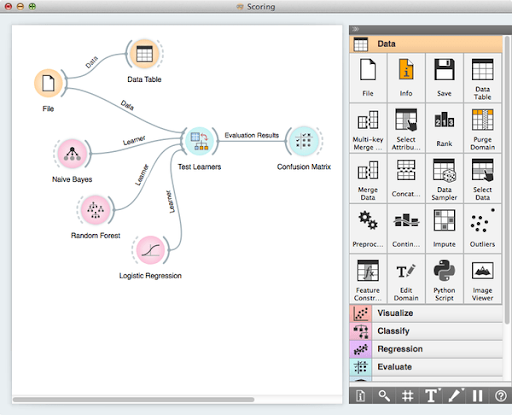
Orange is an open-source, component-based visual workbench built around widgets (nodes) and workflows. It’s popular for fast exploration, teaching, and lightweight modeling, with add-ons for things like text mining and network analysis.
Main features
- Visual, widget-based workflows for exploration, preprocessing, modeling, and evaluation
- Add-ons to extend functionality
- Can be used via UI or as a Python package
Price: Free and open source.
Best for: Fast, visual exploration and lightweight modeling.
4. Weka
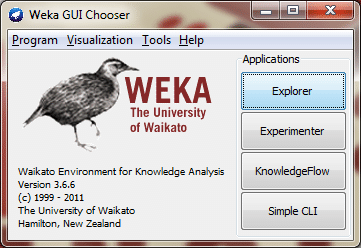
Weka is a long-running, open-source ML and data mining workbench in Java, widely used in academia and for classic algorithm experimentation. It includes multiple user interfaces (e.g., Explorer, Knowledge Flow, Experimenter) for interactive analysis and repeatable evaluation.
Main features
- Open-source ML toolkit in Java
- Multiple interfaces for interactive mining and experimentation
- Broad set of classic methods (classification, regression, clustering, association rules)
Price: Free and open source.
Best for: Teams doing classic ML baselining and benchmarking and algorithm experimentation in a GUI-first Java workbench.
5. Elki

Elki is an open-source Java toolkit focused on unsupervised methods, especially clustering and outlier detection, with an emphasis on algorithm research and extensibility.
Main features
- Strong emphasis on clustering and outlier detection
- Performance-oriented structures (e.g., index structures) for certain algorithms
- Research-friendly, extensible Java toolkit
Price: Free and open source.
Best for: Unsupervised mining, particularly outlier and anomaly detection and clustering useful for exploratory risk engineering pattern discovery.
6. Analytic Solver Data Mining
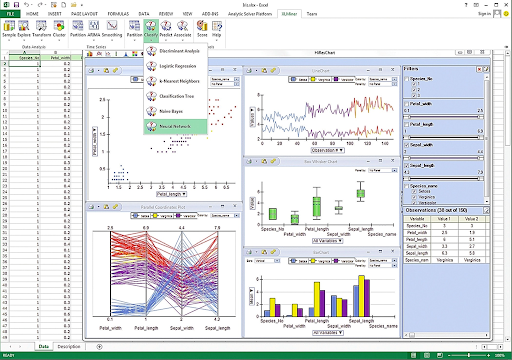
Analytic Solver Data Mining (formerly XLMiner) is an Excel add-in aimed at business analysts who want data mining methods inside Excel. It covers a wide set of classic predictive and unsupervised techniques without forcing a separate DS stack.
Main features
- Excel-native data mining methods, including trees and clustering
- 15-day free trial offering
- Optional desktop and cloud modes depending on packaging
Price: ~$2,500 for a single-user, one-year license.
Best for: Excel-first analysts who want trees, clustering, regression. and other mining methods without leaving spreadsheets.
Category 3: Industry-or-Vertical-Specific Solutions
7. KoBold Metals
KoBold Metals is a scientific mineral exploration and development company that uses AI to make mineral discovery more repeatable. It’s included here because it’s a strong example of vertical data mining applied to geoscience, where the “platform” is built around specialized datasets, sensors, and predictive models rather than generic ML tooling.
Main features:
- Organizes disparate geoscience inputs so they are standardized and searchable
- Focuses on collecting higher-quality data to reduce uncertainty
- Uses models to improve where and how to look for deposits
Price: Partnership and project-based rather than self-serve SaaS.
Best for: Organizations pursuing AI-driven mineral exploration that need a partner built around geoscience data fusion.
8. Slingshot Aerospace

Slingshot Aerospace offers a platform for space operations intelligence and space domain awareness, turning disparate space data into a common operational view using tracking, AI, astrodynamics, and data fusion.
Main features:
- Includes 50,000+ spacecraft records and is updated daily with seradata satellity and launch intelligence.
- Modeling, simulation, and coordination workflows
- Fuses sensor and network data, databases, and third-party space data into a dynamic operational picture
Price: By inquiry.
Best for: Satellite operators, space agencies, and defense teams that need space domain awareness.
9. GoMetro

GoMetro is a mobility and fleet platform focused on telematics aggregation and fleet operations. Its Bridge product is positioned as a way to consolidate fragmented vehicle data into real-time visibility and reporting.
Main features:
- Integrates multiple telematics systems and consolidates data
- Advanced reporting, route optimization, and efficiency improvements use cases
- Telemetry and data aggregator and SaaS fleet management platform
Price: By inquiry.
Best for: Fleet and transit operators needing telematics consolidation and operational analytics.
Category 4: Enterprise DS/ML Platforms For Scale and Deployment
10. Dataiku

Dataiku is an end-to-end enterprise platform for taking ML from experimentation to production with strong emphasis on governed MLOps and cross-functional collaboration.
Main features
- Unified flow from prep and feature engineering to model build and deployment
- MLOps governance features like automated documentation
- Programmatic integration via Python API into CI/CD tools
Price: By inquiry.
Best for: Enterprises that need cross-team collaboration and MLOps controls.
11. Alteryx

Alteryx is an enterprise analytics automation platform designed to help teams prep, blend, automate, and govern analytic workflows at scale. It’s used heavily by analytics and operations teams, not just data scientists.
Main features
- Transparent, auditable workflows with built-in lineage
- Cloud-based workflow build and automation via Designer Cloud
- Cloud, on-prem, and hybrid, with enterprise-grade controls
Price: The Starter Edition is $250 USD/user/month. Contact sales for Enterprise.
Best for: Analytics and ops teams scaling repeatable data prep and analytics automation.
12. BigML

BigML is an end-to-end ML platform that emphasizes a standardized framework for building and operationalizing predictive models (GUI and APIs), aiming to reduce tool sprawl and technical debt.
Main features
- Broad ML coverage plus collaboration and automation building blocks
- Programmable and repeatable workflows
- PRIME account options by capacity and parallelism needs
Price: Tiered based on subscriptions and private deployments.
Best for: Teams that want an API-forward ML platform to build and operationalize predictive models.
13. TIBCO

TIBCO’s Spotfire Statistica is positioned as a comprehensive analytics and data science environment for building deployable analytic workflows and publishing them to business users.
Main features
- Build analytic workflows that can be packaged and published to business users
- Create and deploy statistical, predictive, data mining, ML, forecasting, optimization, and text analytic models
- Tied into the Spotfire ecosystem
Price: By inquiry.
Best for: Organizations already in (or aligned with) the Spotfire and TIBCO ecosystem that want deployable analytics workflows.
14. Minitab SPM
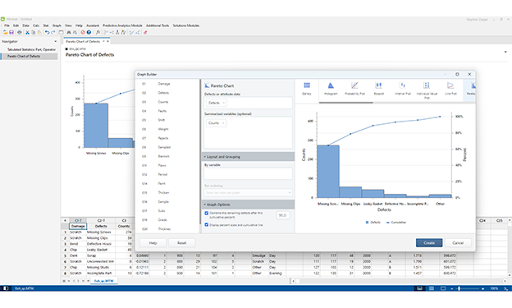
Minitab’s Salford Predictive Modeler (SPM) is a specialized predictive modeling suite designed for enterprise-grade modeling using well-known engines.
Main features
- Core modeling engines: CART®, MARS®, TreeNet®, Random Forests®
- Covers classification, regression, survival analysis, missing value analysis, and more
- Positioned within Minitab’s broader portfolio
Price: By inquiry.
Best for: Teams that want battle-tested predictive engines for high-stakes modeling in domains such as risk and regulated operations.
Category 5: AI Acceleration Platforms
15. Altair AI Studio

Altair AI Studio (formerly RapidMiner Studio) is a visual, workflow-driven environment designed to help teams prototype and productionize explainable ML faster. It is especially helpful if you want drag-and-drop build with optional scripting.
Main features:
- Visual drag-and-drop workflow designer
- AutoML capabilities that explicitly cover automated clustering, predictive modeling, feature engineering, and time series forecasting
- Generative AI functions
Price: By inquiry.
Best for: Teams that want to accelerate model prototyping in a visual, explainable workflow environment.
16. H2O.ai
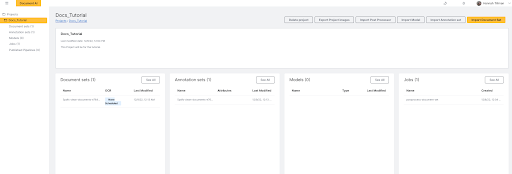
H2O AI Cloud is an enterprise platform that bundles AutoML, model operations, and app delivery. It offers Driverless AI for building strong tabular models quickly, plus packaging options to operationalize them.
Main features:
- MLOps-grade deployment controls
- Automates key DS steps, e.g., feature engineering
- Multiple deployment paths, including creating a REST endpoint or exporting highly optimized Java code for edge scenarios
Price: By inquiry.
Best for: Organizations that want to ship strong tabular models fast via AutoML.
Turn Analysis into Shared Context
Not all data mining tools solve the same problem. Some are built for fast exploratory discovery, some are designed to operationalize repeatable pipelines, and others exist to ship models with governance and deployment controls. The right choice depends on what you are optimizing for.
But for many teams, the bigger challenge is making results usable and trustworthy across the business. Jedify’s governed semantic context layer fuses operational data, BI logic, and business knowledge into the shared context that AI agents and analytics workflows can rely on. If your goal is to move beyond isolated insights and enable consistent natural-language investigation and agentic apps across teams, you need more than a mining tool: you need context infrastructure.
Book a demo to see how Jedify helps your agents reason with business context, not just data.