


Ten years ago, self-service tools revolutionized analytics. They gave business teams the power to analyze data independently, without relying on IT. Business users could slice and dice their data, uncover trends, and generate reports with unprecedented ease. But as transformative as this shift was, it reflected a simpler time for data.
Fast forward to 2025, and the data landscape has changed beyond recognition. Data has grown exponentially in volume, velocity, and variety. Businesses face torrents of structured and unstructured data from myriad sources, creating unparalleled complexity. Data teams have exploded in headcount and data titles started to pop up – such as data engineering, architecture, science, and dev. These ever-growing teams continue to work hard to meet these challenges, wrestling unruly data pipelines and wrangling raw inputs into something usable.
And analytics tools? They’ve stagnated, growing bloated and overly complex. As one analyst told us recently, “Find me a data or business person who loves _____, and I’ll treat you to a $500 Omakase dinner.”
The problem: A lot of data, but little business context
How did we get here? What went wrong?
Each company has its own specific metrics, workflows, processes, and definitions, layered with a unique business language spoken across its teams. Analytics tools struggle to leverage this business context, especially in today’s complex data environments. Data analysts and engineers spend weeks and months modeling data, meticulously crafting semantic layers and YAML files to capture business rules. As businesses face a constant influx of new data sources and shifting requirements, traditional semantic layers struggle to keep up. Adjusting and adapting them is an ongoing, labor-intensive process that can stifle innovation and slow decision-making.
The result? Sluggish decision-making, delayed actions, and missed opportunities, a recipe for losing to the competition.
Generative AI (BI) to the rescue?
Not so quickly.
So far we’ve seen many efforts fall short. The industry giants are adding genAI driven Co-pilot-like experiences into their existing products, but retrofitting a general purpose LLM onto a rigid, pre-existing, data model doesn’t solve the underlying problem. These solutions still don’t understand the nuanced questions well enough. Traditional semantic models are just not designed to address the dynamic nature of language driven analytics, and are optimized for static and predefined workflows.
Enter Semantic Fusion: The Breakthrough of 2025
In early 2024, a group of data scientists, engineers, and product visionaries came together with a bold mission: to empower organizations with data intelligence that matches the demands of the AI age. We envisioned a solution capable of seamlessly integrating nuanced business context with data from both structured and unstructured sources.
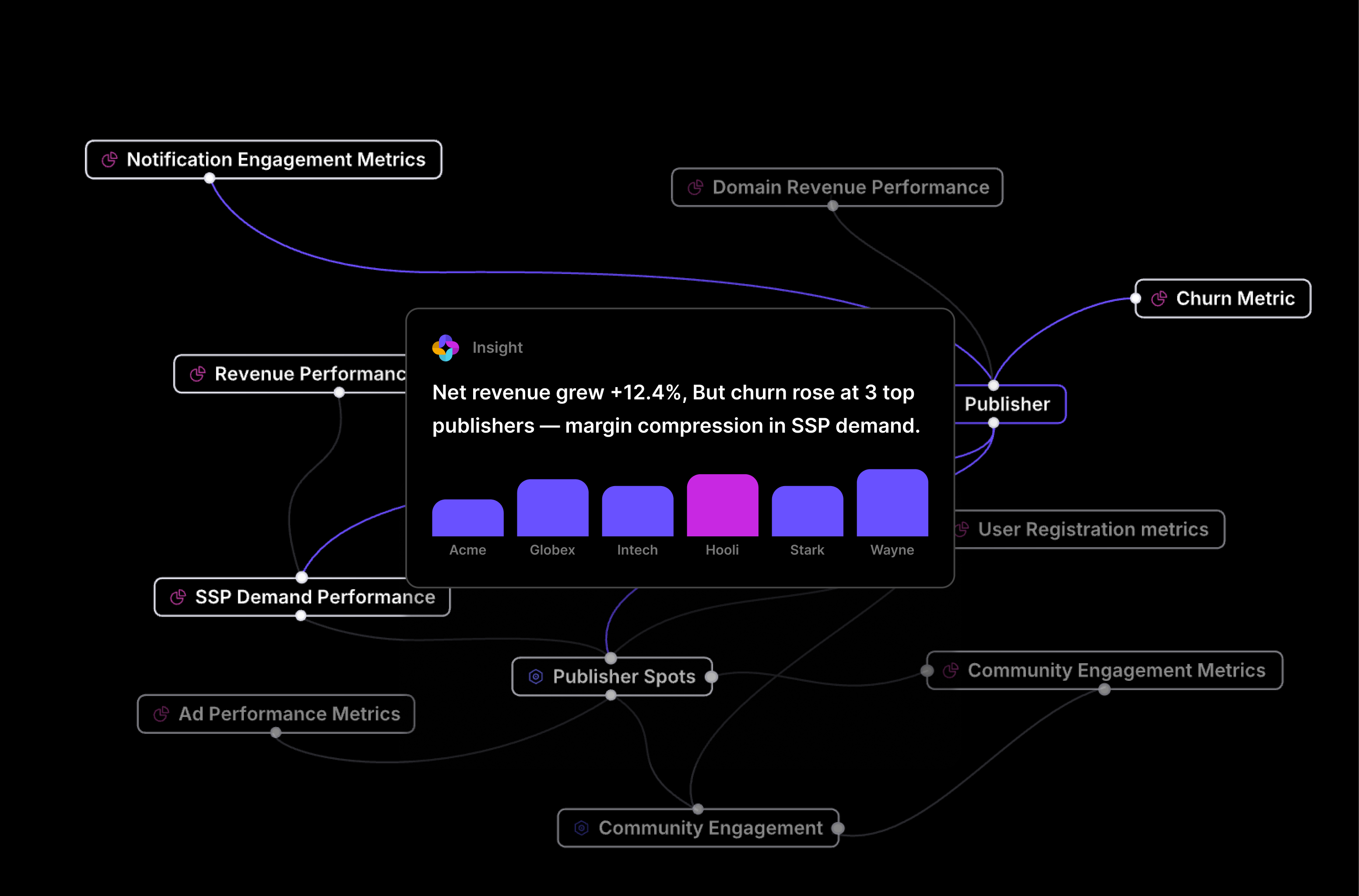
The result of their efforts is Semantic Fusion, a groundbreaking technology that introduces an intelligent, dynamic application layer. This layer bridges the gap between business context and raw data, enabling organizations to:
- Understand intricate questions: Semantic Fusion can grasp even the most nuanced business inquiries, applying the right methodologies and leveraging the appropriate models to deliver precise answers.
- Adapt in real time: Unlike traditional semantic layers, Semantic Fusion evolves dynamically, accommodating new data sources, business rules, and user needs without extensive rework.
- Empower teams with “Jedi powers”: This technology equips organizations with the intelligence to generate insights, answers, and analytics tailored to their unique needs, enabling teams to perform at their best.
Semantic Fusion represents a paradigm shift in how organizations leverage data. By dismantling the rigid frameworks of the past and embracing a fluid, adaptive approach, it’s redefining what it means to be data-driven. With Semantic Fusion, companies can finally unlock the full potential of their data—delivering the intelligence, agility, and innovation needed to thrive in the age of AI.
Some of the world’s most sophisticated tech companies and largest brands are already enjoying their new “Jedi Powers.” They’re harnessing Semantic Fusion to overcome the limitations of traditional approaches, transforming how they operate and compete in the market.
And as they say, we’re just getting started.
2025, here we go!