Abstract
What is a semantic layer?
A semantic layer is a governed abstraction between raw data and its consumers (BI tools, apps, and AI agents) that translates physical schemas into shared business meaning. This article explains why that becomes critical in the agent era, then breaks down eight essential components (governance, lineage, drift management, MCP delivery, and coverage beyond tables via BI logic and business knowledge) and shows how to operationalize this with Semantic Fusion™ and contextual MCP delivery.
Every Monday follows the same script: Finance presents one revenue number, Sales presents another, and engineers burn half the week tracing duplicated logic scattered across dbt models and BI dashboards. Stakeholders stop trusting the data. Teams stop trusting each other. The cost isn’t just operational friction. It’s a structural ceiling on everything AI is supposed to unlock.
23% of organizations report they’re scaling agents in at least one function, and another 39% are experimenting. One common bottleneck is often the absence of a well-maintained semantic layer. Without a governed abstraction layer to translate raw data into business concepts, teams are forced to hardcode definitions into fragile, one-off prompts.
Solving this requires more than better tooling or cleaner pipelines. It requires a shared architectural contract between your data and everything that consumes it, be it human or machine. That contract is the context graph. This post breaks down its eight essential components: what each one does, why it matters for AI, and how together they form the architectural foundation that turns fragmented enterprise data into something agents can actually reason over.
What is a semantic layer?
A semantic layer is a governed abstraction that sits between your raw data and everything that consumes it.
It translates complex physical schemas into unified business meaning, including not just column names, but also the logic, relationships, and definitions that reflect how your organization actually operates.
- Business vocabulary: A shared definition of core entities and metrics, such as “Active Customer” or “Contracted ARR,” that captures how the business understands and uses them across teams, systems, and workflows.
- Metric Definitions: The calculation logic for KPIs is defined once, in code, so that ARR, churn, or pipeline coverage produce identical results regardless of which tool runs the query.
- Relationship Model: An explicit map of how records connect across systems, defining safe join paths and preventing the fan-out errors that silently corrupt aggregations.
In the agent era, this becomes core infrastructure: catalogs tell you where data is, metadata tells you what columns exist, and the semantic layer defines how to use them correctly. It’s not a graph database (a storage engine for connected data); it’s the governed contract that makes definitions reusable across consumers.
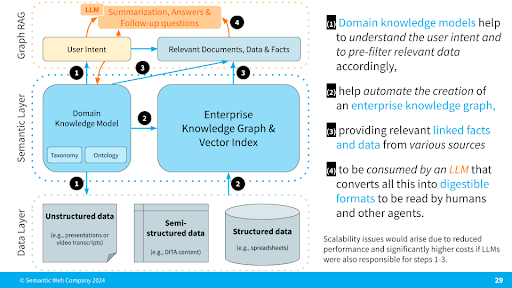
But a context graph built for agents must go further than structured data and metrics alone. It needs to incorporate existing BI and reporting logic alongside unstructured business knowledge (like internal wikis, policy documents, product definitions, sales decks) fused into a single governed data context layer that agents can actually rely on. And it must be maintained with clear ownership, versioning, and review workflows to prevent semantic drift as schemas and definitions change.
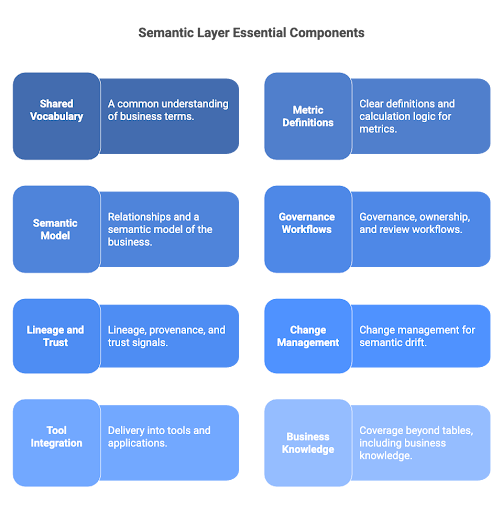
8 Semantic Layer Essential Components
A semantic layer isn’t a single feature but a system of definitions, models, and controls that make business meaning reusable across both legacy BI tools and autonomous AI agents. Building this architecture requires standardizing eight core components, each playing a distinct role in ensuring every downstream consumer, human or machine, works from the same version of the truth.
Essential Component #1 — A Shared Business Vocabulary
Different teams use different words for the same thing. Sales says “closed-won,” Finance says “booked revenue,” and your data model reflects neither. A shared business vocabulary solves this by embedding natural-language metadata, synonyms, and entity definitions directly into your context graph.
When an AI agent parses a query, the taxonomy maps ambiguous phrasing to a structured registry of core business objects, eliminating the need for brittle, domain-specific prompt engineering to compensate.
Essential Component #2 — Metric Definitions and Calculation Logic
ARR calculated in Finance should equal ARR calculated in your agent’s output. Metric definitions enforce this by encoding KPI logic (such as aggregation rules, time grains, and dimensional filters) directly in the context graph rather than in individual BI tools or prompt templates. For autonomous agents, consistent metric logic is critical infrastructure; without it, ARR is just a guess with a SQL costume.
When any system queries for churn or pipeline coverage, it pulls from the same formula. For autonomous agents, this predictability is non-negotiable: inconsistent aggregations produce incorrect answers.
Essential Component #3 — Relationships and a Semantic Model of the Business
Raw schemas rarely make safe join paths obvious. A semantic relationship model maps how entities connect across systems by defining valid foreign-key paths, cardinality rules, and traversal constraints that prevent fan-out errors and corrupted aggregations.
For AI agents, this blueprint is critical: without explicit relationship definitions, agents are left to infer join logic from column names and schema structure, which produces incorrect results at scale.
Essential Component #4 — Governance, Ownership, and Review Workflows
Semantic definitions are production code, and you should treat them as such. In multi-agent AI systems, these controls prevent ‘definition drift’ between agents as logic changes over time.
This means versioning your context graph in Git, enforcing code ownership rules so that changes to metric logic require sign-off from qualified reviewers, and running automated linting and schema validation before any definition reaches production. This governance layer is what separates a trustworthy agent from one that begins to provide wrong answers every time a schema changes upstream.
Essential Component #5 — Lineage, Provenance, and Trust Signals
Knowing that a metric is defined correctly is only half the picture. Agents also need to know whether the underlying data is up to date, complete, and reliable. Lineage tracking surfaces transformation paths from source to output, while provenance metadata exposes execution latency, freshness timestamps, and data quality signals.
This gives autonomous systems the context to evaluate data fidelity before triggering downstream actions (rather than executing confidently against stale or incomplete inputs).
These trust signals are a core part of data governance for agents because governance isn’t just access control, it’s knowing what the numbers mean and whether they’re safe to act on
Essential Component #6 — Change Management for Semantic Drift
Schemas change, definitions evolve, and correct logic quietly becomes wrong. Treat your context graph like an API: use semantic versioning for definitions, run automated contract tests against known-good queries (and a small suite of golden business questions), and continuously diff upstream schemas to detect breaking changes early.
That discipline is part of AI threat readiness, preventing definition or schema changes from cascading into automated actions based on outdated logic. For agents, add runtime guardrails: if lineage/freshness checks fail or a definition is deprecated, the agent should downgrade to a safe explanation instead of taking action. Pair this with rollout controls (feature flags/canaries) so that meaning updates don’t break production workflows.
Essential Component #7 — Delivery Into Tools and Applications
A context graph only delivers value if agents and applications can reliably consume it. Modern delivery architectures expose semantic context through SQL endpoints, REST APIs, and GraphQL interfaces. As agents become first-class consumers, access should be scoped and auditable using non-human identities, so each agent/tool call runs with least privilege rather than a shared ‘god token.’
For AI agents, one emerging standard is MCP—an open protocol for exposing governed tools and context to language models. With the right server implementation, agents can discover available datasets/definitions via those interfaces and fetch context programmatically. It reduces the need to re-implement semantic definitions for each new agent or app by standardizing how that governed context is exposed and consumed.
Essential Component #8 — Coverage Beyond Tables (Business Knowledge)
Most context graph implementations stop at structured data and metric definitions. For AI agents, that’s not enough. Business context lives in wikis, policy documents, product specs, and sales decks, and agents need access to that knowledge.
Fusing unstructured documentation with structured warehouse models into a single governed context layer enables hybrid retrieval strategies that bridge relational data and organizational knowledge. This is an increasingly common requirement in agent-era architecture, and the clearest gap between traditional tools and what agents actually require.
The Problem The Semantic Data Layer Solves
Enterprise AI initiatives stall because they are suffocated by semantic fragmentation, not because teams lack access to data. In a typical data stack, critical enterprise concepts (such as ARR, active customers, or pipeline stages) are scattered across custom transformation scripts and application logic.
This fragmentation creates two major architectural problems:
- The Reactive Engineering Loop: Data and analytics groups get trapped constantly rebuilding identical metrics for disparate downstream endpoints, or manually reconciling mismatched KPI reports for stakeholders.
- Autonomous Agent Failure: When deployed within this siloed ecosystem, AI agents fail because they lack the institutional business context required to interpret data correctly.
Even custom applications (that initially manage to hardcode these definitions) quickly succumb to severe logic decay. Enterprise operational profiles are inherently fluid. Things like product packaging options evolve, underlying warehouse schemas change, and metric definitions shift. This silently turns your static, prompt-based logic and brittle, hardcoded abstractions into incorrect code over time.
This structural fragility exposes a clear build-vs-buy tension for enterprise data leadership:
- Build an isolated, in-house query connector: Entirely feasible to stand up, but inherently short-sighted.
- Maintain a living semantic abstraction layer: Demands costly engineering overhead across all eight essential components, which often breaks down at operational scale.
Ultimately, a modern semantic data layer solves this core architecture bottleneck by turning scattered enterprise data, embedded BI logic, and unstructured business knowledge into a single, governed semantic context layer that’s reusable across tools and agents.
From a Semantic Layer to a Governed Context Layer with Jedify
A context graph is the contract that turns raw schemas into reusable business meaning—definitions, relationships, and governance that every BI tool and AI agent can rely on. Agents amplify semantic fragmentation: when meaning lives in dashboards and prompts, you get inconsistent metrics, brittle apps, and constant maintenance as schemas and business rules change.
Through three core capabilities, Jedify bridges the gap between raw warehouse storage and reliable, governed, and reviewable reasoning over enterprise context:
The Semantic Fusion™ Engine: Rather than limiting context to basic database schemas, Jedify unifies physical operational data, embedded BI/reporting definitions, and unstructured internal knowledge bases (wikis, decks, and policy spreadsheets) into a single context layer that adapts dynamically as underlying sources evolve.
Contextual MCP Server & SDK Delivery: Jedify programmatically streams this single source of truth straight into your agent infrastructure via Model Context Protocol (MCP). Instead of engineers manually re-implementing definitions across fragile prompt workflows, every AI app pulls live, governed meaning from a centralized runtime engine.
Semantic Change Controls: Built with rigorous software engineering principles, data teams can review, edit, version-control, and fully audit semantic modifications before deployment. This proactive governance ensures logic changes roll out safely without breaking downstream agents or analytics pipelines.
If you’re building agents on top of fragmented metrics and business definitions, Jedify helps you operationalize a governed context layer—so every agent and app pulls from the same meaning. Book a demo to see Jedify on your stack.