When most people think of a database, they picture the rigid rows and columns of a relational system: essentially a high-powered Excel spreadsheet. These tables are great for aggregating totals, but they struggle when the question requires relationships, hierarchy, dependency chains, or multi-hop reasoning.
You can answer questions like “Which deals are blocked by the same security review step?” in a relational model, but it often means multiple joins across multiple tables. That approach gets expensive and brittle as relationship depth grows.
That shift in workload is one reason graph systems have gone mainstream. As apps become more relationship-driven, graph databases have sustained 20%+ annual growth, showing up across fraud, IT dependency mapping, supply chain visibility, and AI context workloads.
When it comes to large and complex datasets, enterprises have a hard time ensuring connected records have shared meaning. For example, canonical definitions and explainable provenance. Enterprise agents also need governed meaning, so answers stay consistent across teams.
That’s why modern agentic systems increasingly need a governed business context: the definitions and logic that explain what the data means in your business, not just where it lives.
What is a graph database?
A graph database is a specialized storage engine that uses a flexible structure composed of nodes (entities like people or products) and edges (the connections between nodes, such as “purchased” or “constructed”).
Knowledge graphs have been operationalized for decades in high-stakes environments; Palantir is often cited as an early company that productized graph-based representations.
Instead of treating relationships as something you reconstruct at query time, graph databases store them directly, which makes it easier to answer questions that require traversal rather than aggregation.
Two common graph data models you’ll hear about are:
- Labeled Property Graphs (LPG): Nodes and relationships can both carry properties. Common in application development and operational graph workloads.
- RDF triples: Data represented as subject–predicate–object triples, often used where standards-based interchange and formal semantics matter.
Graph databases are one option for representing durable relationships and dependencies that agents may need to reference over time. But graphs don’t automatically supply data context—the definitions and rules agents need to interpret those relationships correctly.
For an AI agent to act independently, it needs to understand the context and the ripple effects of its actions. A graph provides a map of business entities and their dependencies, enabling agents to perform Graph RAG (Retrieval-Augmented Generation) and navigate complex dependencies to provide more accurate, grounded reasoning.
For autonomous agents, the graph is the structure that makes dependencies explicit, so the agent can plan, check constraints, and trace impact before it acts.

Graph Database vs Knowledge Graph vs Semantic Layer
These terms get used interchangeably, but they’re not the same thing.
Graph Database
A graph database is the base layer, providing storage and a query engine for managing highly interconnected data. By itself, it doesn’t actually “understand” the business logic, semantics, or ontologies of the data it holds.
Knowledge Graph
A knowledge graph adds capabilities like ontology management, entity resolution, and logical reasoning to the data stored in the graph database. This additional layer of meaning allows the system to follow explicit chains of reasoning.
Semantic Layer
A semantic layer is the highest level of abstraction, focusing on standardizing terminology and metrics across different systems. It is about governed meaning:
- Canonical definitions for metrics
- Business logic and calculation rules
- Consistent dimensions and terminology
- Access controls and policy enforcement
- Versioning and change management
In practice, many teams have some semantics embedded in BI tools and documents, but that meaning is fragmented and hard for agents to reuse consistently.
Graph structure helps agents answer “what’s connected.” But in enterprise workflows, the harder question is which Revenue definition, which churn logic, which customer tiering rules, which exceptions apply, and what changed last quarter.
That’s the job of a governed semantic context layer. It provides reusable definitions, BI logic, and business knowledge with provenance, permissions, and versioning, so multiple agents don’t drift into conflicting answers.
Core Concepts of a Graph Database
Nodes (Entities)
Nodes represent real-world entities such as customers, products, devices, or locations. They can be tagged with Labels (like “Person” or “Employee”) to group entities and support targeted queries.
Relationships (Edges)
Relationships are typed, often directional links between nodes that represent interactions or dependencies. In graph databases, relationships are stored explicitly, making connected queries easier to express than reconstructing links at query time.
Properties
Properties are key–value attributes on nodes and relationships (e.g., timestamps, amounts, status) that add the details needed for filtering and analysis.
For example, here are two nodes and one relationship with their properties:
- Node A: Label: Customer, Properties: name: “Alice”, id: 123
- Node B: Label: Product, Properties: product_number: “AB-123”, price: 29.99
- Relationship: PURCHASED (Direction: from Alice to Product). Properties: discount_applied: true, date: “2026-04-25”.
Traversals
A traversal follows relationships across one or more hops to answer connected questions. In relational systems, multi-hop relationship questions can require multiple joins. In graph systems, traversals can often be executed more directly because adjacency is represented as part of the stored structure.

Common Graph Database Use Cases
Fraud & Risk Analysis
Conventional fraud detection systems often analyze events in isolation, leaving them blind to coordinated attacks. Fraudsters frequently use synthetic identities that share underlying attributes, such as IP addresses, phone numbers, or devices.
Graph databases excel at exposing these hidden connections and circular transaction loops (e.g., money moving through multiple accounts before returning to the source) by analyzing the network of relationships, allowing organizations to block fraudulent activity in real time.
Personalization & Recommendation Engines
Modern recommendation engines depend on mapping intricate webs of users, items, categories, and interactions. By storing these elements as interconnected nodes and edges, graph databases can execute real-time traversals to find products bought by similar users or within specific communities.
They also allow organizations to easily and seamlessly integrate new behavioral signals, like location trends or social influence, without having to restructure the underlying architecture.
IT Dependency Mapping
Enterprise IT environments are incredibly complex, filled with interconnected services, hosts, containers, APIs, and alerts. Graph databases model infrastructure topologies directly, enabling rapid root cause analysis during outages.
Instead of stitching together separate logs and monitoring tables, incident response teams can query the graph to see upstream dependencies, downstream impacts, and the blast radius of a failing component.
Agentic AI Context & GraphRAG
Graph-based retrieval can be valuable when an AI system needs to answer multi-hop questions over entities and relationships.
GraphRAG approaches use a graph structure to retrieve relevant subgraphs (e.g., entities and evidence) and provide them to the model. Done well, this can improve grounding and make it easier to explain how an answer was derived.
But the failure mode in enterprises is that different systems encode different definitions:
- “Revenue” in finance vs. “Revenue” in sales
- “Active customer” defined one way in a dashboard and another way in a slide deck
- Policy exceptions living in docs that never make it into the data model
Graph structure helps. Governed semantic context prevents drift. Together, they improve grounding for LLMs in agent workflows.
Supply Chain Visibility
Supply chains are networks of suppliers, sub-suppliers, components, manufacturing plants, and logistics routes. A graph database models these multi-tier dependencies explicitly, allowing organizations to quickly identify single points of failure or concentration risks.
If a disruption occurs at a specific point, operations teams can immediately trace the impact paths to see exactly which downstream products or customers will be affected.
Types of Graph Databases, and How to Choose
Property Graphs
Property graphs are commonly used for application development and operational graph workloads. They model data as nodes and relationships, where both can carry properties, and queries typically operate on the relationships explicitly stored in the graph. Common query languages include Cypher, Gremlin, and emerging standards such as GQL (availability varies by vendor).
Some teams pair LPGs with graph analytics tooling to run global algorithms (e.g., similarity or community detection), but for many enterprise AI use cases, the bigger challenge is ensuring agents share the same definitions, logic, and provenance when they interpret connected data.
RDF Graphs
Originating from the semantic web and linked data standards, RDF graphs model data as triples (subject – predicate – object). They prioritize global data integration and formal semantics and rely on “open-world” semantics, where missing information is treated as unknown rather than definitively false.
RDF is commonly used to build knowledge graphs because triples map well to entity–relationship representations and standards-based vocabularies.
How to Choose
Choosing between a Labeled Property Graph (LPG) and an RDF graph ultimately comes down to your primary architectural goal.
- LPG maps well to real-time analytics and fraud detection, recommendation engines, and application development and GraphRAG.
- RDF maps well to cross-organizational data sharing, scientific research, and metadata management, and environments where strict standards compliance, formal semantics, and explainable reasoning are legally or operationally required.
| Dimension | Property Graphs (LPG) | RDF Graphs |
| Data model | Nodes + relationships (both can have properties) | Triples: subject–predicate–object |
| Best for | Apps + operational traversals | Standards + interoperability |
| Query language | Cypher / Gremlin (GQL varies) | SPARQL |
| Typical use cases | Fraud, recommendations, GraphRAG, app dev | Knowledge graphs, metadata, cross-org sharing |
| Choose when | You need fast relationship queries in a specific system | You need formal semantics + shared vocabularies |
Where Graph Projects Fall Short For Enterprise AI
Graph databases can make connected queries easier. Yet, teams still struggle to make agents reliable because the failure is usually semantic, not structural:
- Definitions live in too many places.
- Schemas and business rules change, but agents keep using old assumptions.
- Every agent or app reimplements logic slightly differently.
- Without permissions, provenance, and versioning, it’s hard to audit why an agent answered the way it did.
For multi-agent AI, these issues compound. Conflicting definitions get repeated and reinforced unless meaning is governed centrally. This shows up in domains like smart manufacturing and IT dependency mapping, where traceability and quality depend on consistent definitions across systems.
Best Practices for Modeling Graphs
- Design for the Query: Map your structure to support specific multi-hop traversals. Start with your most critical business questions to ensure the graph supports the necessary search paths.
- Enforce Strict Schemas: Enforce schemas and constraints (labels, relationship types, property constraints) where your graph system supports them.
- Prioritize Entity Resolution: Don’t mirror source systems (CRMs/ERPs). Map data to stable business concepts (like Product or Supplier). Define clear rules for identity to avoid duplicating nodes for the same real-world entity.
- Capture Provenance as Evidence: When merging records, store the “why” (the evidence) as a connected edge to the identity node. This lets you trace and refine matching logic over time.
- Standardize Vocabulary: Use Nouns for node labels and Verbs for relationship types. Never allow anonymous nodes and require a minimum set of defining attributes (like a unique ID) for ingestion.
Best Practices for Performance and Operations
- Optimize Entry Points: Use Indexes and Constraints on frequently searched properties (like emails, IDs) to avoid expensive full-graph scans.
- Leverage Node Labels: Tag nodes with logical labels so the engine can instantly narrow its search scope to a specific subset of the data.
- Neutralize Supernodes: Avoid connecting thousands of edges to a single node (like “Country”). Instead, store generic attributes as properties on the individual nodes to prevent navigational bottlenecks.
- Guardrail Traversal Depth: If highly connected nodes are unavoidable, set strict depth limits on queries to prevent the database from spiraling into a hotspot scan.
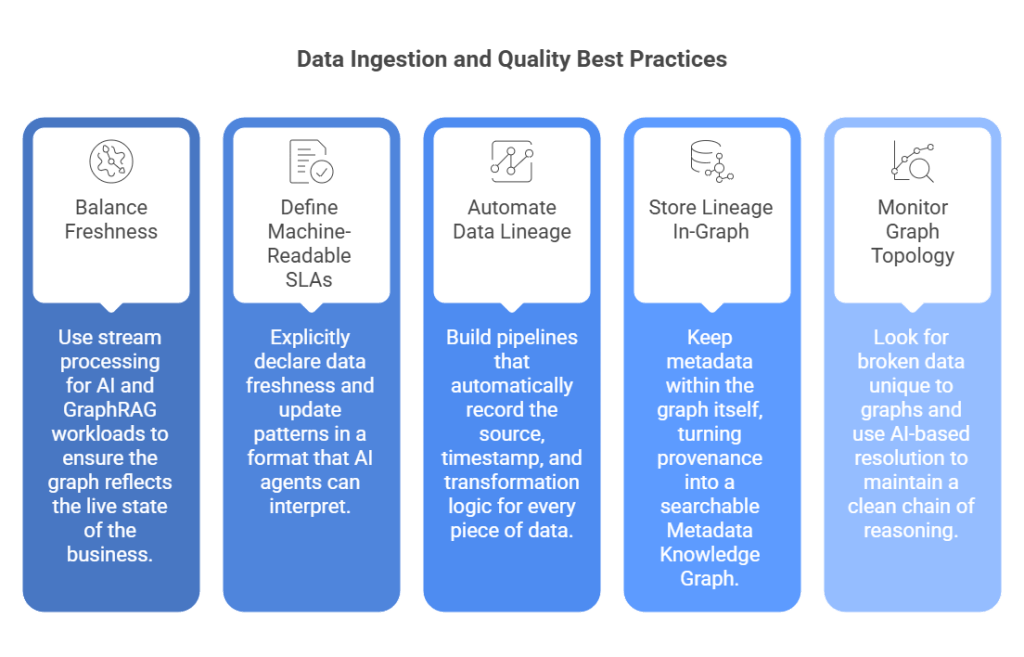
Best Practices for Data Ingestion and Quality
- Balance Freshness: For AI and GraphRAG workloads, move beyond batch processing. Use stream processing to ensure the graph reflects the live state of the business, preventing hallucinations caused by stale data.
- Define Machine-Readable SLAs: Explicitly declare data freshness and update patterns in a format that AI agents can interpret before they rely on the information.
- Automate Data Lineage: Build pipelines that automatically record the source, timestamp, and transformation logic for every piece of data.
- Store Lineage In-Graph: Keep metadata within the graph itself. This turns provenance into a searchable Metadata Knowledge Graph that AI can use to explain its reasoning.
- Monitor Graph Topology: Look for broken data unique to graphs, such as missing edges, broken references, or duplicated entities. Use AI-based resolution and human-in-the-loop workflows to maintain a clean chain of reasoning.
How Graph Databases Connect to Agentic Systems
The “Shared Meaning” Gap
Autonomous agents often fail in the enterprise because they lack a common language. While they can fetch data, they cannot distinguish which definition of “Revenue” or “Customer” is the canonical truth. In multi-agent AI, the risk compounds: different agents can reinforce conflicting interpretations unless meaning is governed centrally. This leads to:
- Interpretation Drift: Multiple agents generating parallel, conflicting answers.
- Reinforced Error: Agent memory repeats incorrect definitions unless those definitions are strictly anchored to a governed source.
Graphs as Cognitive Infrastructure
Graph architectures solve the structural half of this problem by providing a natural map of the business:
- Multi-Hop Reasoning: Interconnected nodes and edges allow agents to navigate complex hierarchies and synthesize answers across domains.
- Entity Resolution: Graphs link fragmented records from disparate systems into unified, reliable identities.
The Missing Link: Governance
A graph database can store relationships, but it won’t automatically tell an agent:
- Which metric definition is canonical
- Which business rule applies to this timeframe
- Whether the data is fresh enough to rely on
Without governance, multiple agents produce conflicting answers, and incorrect memory gets repeated because nothing anchors meaning to a controlled source. Hence, Agent-ready context needs:
- Canonical Definitions: Approved formulas for metrics and business rules.
- Temporal Logic: Clarity on which rules were active during specific timeframes.
- Security & Provenance: Versioning, access permissions, and a clear audit trail of where data originated.
This is where teams need AI strategic visibility, which is the ability to trace an agent’s output back to the definitions, sources, and policies that shaped it. As a result, data teams can debug drift, security teams can audit access, and leaders can trust decisions.
Bridging the Gap: From Connected Data to Governed Meaning
Graph databases help with connected queries. But enterprise AI reliability usually breaks somewhere else: meaning. Graphs can help represent relationships, but Jedify’s focus is governed business context that agents and apps can reuse.
Jedify is a contextual data platform for AI agents. It connects to your data stack and business knowledge, then turns fragmented operational data, BI logic, and institutional knowledge into a shared, governed semantic context layer that agents and AI apps can use consistently.
Jedify’s core differentiator is Semantic Fusion™. This is a living semantic layer that fuses structured and unstructured context and stays current as sources, schemas, and business definitions evolve. That shared context can then be delivered to other systems and applications through a contextual MCP server or SDK, so you don’t rebuild brittle definitions inside every agent or prompt.
Jedify anchors agent behavior to governed semantic context. By fusing operational data with BI logic and institutional knowledge, Jedify ensures that meaning is governed, versioned, and explainable. Instead of agents inferring truth from raw topology, they reason from a single, curated source of truth that evolves with your business.
Ready to see governed semantic context in action? Book a demo with Jedify and empower your agents to reason at scale, with accuracy and full explainability.