Abstract
RAG and MCP are often compared as if they were competing approaches to enterprise agents, but they address different layers of the problem. RAG grounds an LLM’s responses in retrieved knowledge, while the MCP (Model Context Protocol) standardizes how agents connect to tools and systems to query data or take action. This article breaks down the differences through five practical enterprise use cases: internal policy Q&A, metric definitions, root-cause investigation, action-taking workflows, and builder/engineering agents.
Most teams compare RAG vs MCP as if they were competing technologies. However, they solve different problems in an agent stack.
A recent enterprise GenAI survey found 74% of organizations report their most advanced initiative is meeting or exceeding ROI expectations, but more than two-thirds say only 30% or fewer of experiments will fully scale.
This article compares RAG and MCP through practical enterprise use cases. The goal is to clarify when retrieval is sufficient, when agents need system access, and when a governed business context is necessary for reliable workflows.
What is RAG?
Retrieval-Augmented Generation, or RAG, gives an LLM access to external knowledge at runtime. Instead of relying only on its training data, the system searches an indexed knowledge source, retrieves relevant content, and passes that context into the model before it answers.
A RAG workflow starts with a user question. Each subsequent step is meant to reduce a specific risk:
Question → retrieve → (optionally rerank) → inject context → generate → (optionally cite sources)
Each step is meant to reduce a specific risk:
- Retrieval reduces knowledge gaps
- Ranking reduces irrelevant context
- Citations help users check the source
- Metadata can help the system choose the right version if you filter or rank on it
RAG works well when the answer depends on text-based knowledge. It reaches its limits when the answer is not in a document but depends on a live system state or on business logic that must be applied consistently.

Governance is often the blocker as workflows expand beyond retrieval into tool access.
Once workflows move beyond retrieval, the blocker is often missing data context and governance: permissioned access, approved sources, and a clear audit trail once agents touch live systems.
What is MCP?
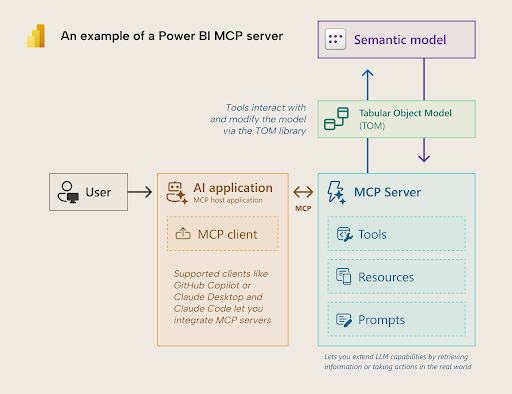
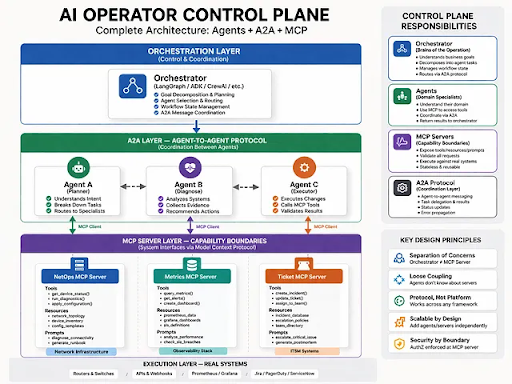
Model Context Protocol, or MCP, is an open standard introduced by Anthropic for connecting AI assistants to external systems. It offers a way to replace fragmented custom integrations with a standard interface for connecting AI systems to all manner of data stores and tools. That changes the architecture because teams can expose approved capabilities once, then let agents query or act across systems through a consistent interface.
Through MCP, agents can connect to capabilities such as:
- Data access for querying warehouses or BI tools
- Developer workflows for repos, issues, tests, or CI/CD
- Business actions for reading or updating CRM or HR records
- Knowledge access for approved docs, policies, runbooks, or internal KBs
MCP standardizes access, but it is not a governance layer. A poorly designed MCP server can expose stale data, broad permissions, or unsafe write actions. Teams need to account for tool misuse, prompt injection, and operational risks that come from giving agents real access to business systems.
In practice, that also means monitoring identity activity across tool calls, including who invoked what, from where, and whether the pattern matches expected behavior.

RAG vs MCP by Use Case
1. Internal Policy & Enablement Q&A (Handbooks, Runbooks, SOPs)
This use case is usually RAG-first because the agent is answering from approved knowledge, not investigating or taking action. A good implementation should index the appropriate handbooks, runbooks, SOPs, and enablement docs, then retrieve the relevant sections. A correct answer should be grounded in the approved document version, not model memory, with a source the user can verify.
MCP can add value when the current system state is needed to provide a correct answer. For example:
- Questions about a PTO policy can reference a handbook, but something like “How many PTO days do I have left?” needs the latest HRIS data.
The main risk is a confident answer from an outdated or unauthorized source. The guardrail is version control plus access control where the agent should answer from approved materials only and stop when retrieved sources conflict.
2. BI Definitions and Reporting Logic
Metric questions expose the limits of plain RAG because a complete and correct answer usually depends on business logic. A glossary can explain what churn means, but it usually will not capture the business rules that determine how the company uses that metric to make decisions.
For BI use cases, a “correct” answer means the agent does not invent or infer the calculation. It should use the company’s approved definition as the source of truth. MCP is useful in this situation because it allows the agent to query the BI tool or the semantic layer directly, rather than relying on retrieved text.
Imagine a user asks, “What is our current ARR?”
- A RAG-only agent might retrieve a dashboard note that defines ARR based on active subscriptions, but this misses the business’s underlying rule that excludes signed contracts until the subscription start date.
- An MCP-enabled agent calls the BI or semantic source where ARR is already modeled according to company rules.
But MCP only provides the access path. It does not create the business context behind the metric. If ARR logic is scattered, the agent still needs a governed way to know which definition is approved (and to keep that consistent across agents).
Jedify’s Semantic Fusion™ layer brings together operational data, BI logic, and business knowledge into a shared context that agents can reuse. That gives agents a governed foundation for applying the same definitions and calculations across systems.
3. Root-Cause Investigation
Root-cause investigation usually needs both RAG and MCP protocol because the agent has moved beyond metric definition and into business analysis. It needs enough context to form a plausible explanation, then enough system access to test that explanation against real data.
A question like “Why did conversion drop?” requires the agent to form hypotheses and show how it reached the answer from the collected data:
- RAG helps provide context for the investigation by retrieving past analyses, customer segment notes, campaign briefs, release notes, support themes, and business definitions.
- MCP adds value when the agent needs controlled access to live data or tools, such as product analytics, CRM records, support tickets, warehouse queries, or BI dashboards.
In this use case, weak controls can mislead the business. The agent needs permission-aware access and consistent join logic, with sufficient validation to prevent it from treating correlation as causation.
A graph database-style context layer can help here by preserving how segments, entities, and definitions relate, so investigations don’t rebuild semantics every time.
4. Action-Taking Workflows (RevOps, Support, Finance Ops)
Workflows that require an agent to actually operate inside business systems should usually be MCP-first. That includes cases where the agent needs to create or change records, update objects, or trigger processes.
MCP gives the agent a controlled way to call the systems where those actions happen. RAG plays a more supporting role, if the agent needs to retrieve text-based information before recommending or taking the next step.
The stakes are especially high in this use case because the agent is changing business state. A bad answer can be corrected quickly, but a bad record update can move through downstream workflows and affect business outcomes.
Organizations need to be able to trust that an agent will take the right action in the right system, under the right permissions, with the right evidence. That’s also where GRC automation starts to matter: policy-driven permissions, approval flows, and audit trails that can stand up to compliance review.
Human-in-the-loop controls are often kept in place for high-risk workflows (where trust is still tenuous), but in either case, the agent should leave a clear audit trail. That consistency is what keeps multi agent AI systems from producing conflicting answers or taking mismatched actions across tools.
5. Builder Workflows (IDE agents, Data/AI Engineering)
Builder workflows are another strong MCP use case. The agent needs access to the toolchain to inspect repositories, query schemas, generate code, run tests, update docs, and help build dashboards. MCP gives these agents a standardized interface for approved toolchain (GitHub, CI/CD systems, warehouses, etc.) access.
RAG will continue to provide architectural context before the agent acts, through coding standards, approved patterns, and other documentation. That context is used to help the agent make changes that fit how the organization builds its software.
The risk depends on how much autonomy the agent has. Review processes can catch most issues when the agent is only suggesting code or drafting documentation. When an agent can merge code or trigger deployments on its own, the risk rises.
MCP also introduces supply-chain risk. Researchers have already flagged concerns such as tool poisoning, malicious tool descriptions, prompt injection, and unsafe trust between MCP servers. MCP should be treated like production infrastructure, with specific safety controls to prevent prompt injection and tool misuse.
How to Choose Between RAG and MCP
The choice depends on where the agent has to get truth from. If the answer lives in approved knowledge, RAG is usually enough, but when the answer depends on a live system, workflow, or business record, MCP becomes more relevant.
If the agent has to interpret company-specific definitions before it answers or acts, the architecture likely needs both, supported by a governed context layer.
| Question to ask | RAG is a better fit when… | MCP is a better fit when… |
| What is the agent trying to do? | Answer from approved knowledge. | Query a system, call a tool, or trigger a workflow. |
| Where does the source of truth live? | Docs, policies, SOPs, runbooks, or KBs. | In BI tools, warehouses, CRM, HRIS, support systems, or other live applications. |
| Does the answer need current state? | Indexed content is enough, as long as it is current. | Needs live records, ticket status, account data, or metric values. |
| Does business logic shape the answer? | Definition is simple enough to retrieve and explain from text. | Needs governed metric rules, joins, filters, or semantic relationships. |
| What is the risk if it is wrong? | Outdated guidance or an unsupported answer. | Wrong action, bad reporting, broken workflow, or unauthorized access. |
| What needs to be logged? | Retrieved source, document version, and user access. | Tool called, system accessed, permissions applied, result returned, and any action taken. |
Jedify Turns RAG and MCP Into Governed Agent Architecture
RAG and MCP solve different parts of the agent problem. RAG grounds the answer in approved knowledge, while MCP provides the agent with a standard way to connect to the tools and systems that support the workflow.
The right choice depends on the use case, but many enterprises will find that their workflows need both. Once teams combine retrieval with tool-calling, there is a governance problem that needs to be addressed.
Agents need consistent definitions, metric logic, entity relationships, and approved sources that can be managed, versioned, and reused across workflows. Without this, every agent may reach the right systems but come back with a slightly different version of the truth, creating conflicting answers, duplicated context work, and automation that teams do not fully trust.
Jedify’s argument is that agents need a shared, governed context layer. Jedify is a contextual data platform for AI agents, using Semantic Fusion™ to fuse business context with multi-source data into an AI-ready context layer. Its MCP Server or SDK can then stream that context into agentic applications on the platform of choice.
Book a demo to see how Jedify helps teams build agents that can retrieve, act, and reason from the same governed business context.